
Introduction
Simultaneous charging and discharging is a common feature in modern power banks, especially those with multiple ports and high-power USB-C support. However, how power is actually distributed between input charging and output delivery is often not clearly visible.
In today's article, ChargerLAB uses the POWER-Z KM003C to test the real behavior of a power bank during pass-through charging. We set up a simple measurement system to record input and output power at the same time, and observe how the device manages different load conditions, including cases where the battery also assists in output.
1. Test Equipment
- Test instrument: POWER-Z KM003C
- Number of testers: 2 or more
- Power banks: Dual-port and multi-port models
- Chargers: 140W PD charger
- Load devices: Smartphones, laptops
- Cables: 140W and 240W USB-C cables
2. Measurement Setup
- Input path: Charger → POWER-Z KM003C one → Power bank input port
- Output path: Power bank output port → POWER-Z KM003C two → Load device
3. Test Procedure
- Connect the setup according to the measurement diagram and power on the system.
- Wait until the POWER-Z KM003C displays a stable power state (pay attention to current direction).
- Record voltage, current, and power on both input and output sides, and check whether fast charging protocols are properly negotiated.
- Enable the data recording function to capture fluctuations during pass-through charging and save complete test data.
4. Pass-Through Charging Test with POWER-Z KM003C
Scenario 1: Standard Pass-Through Charging (Input > Output)
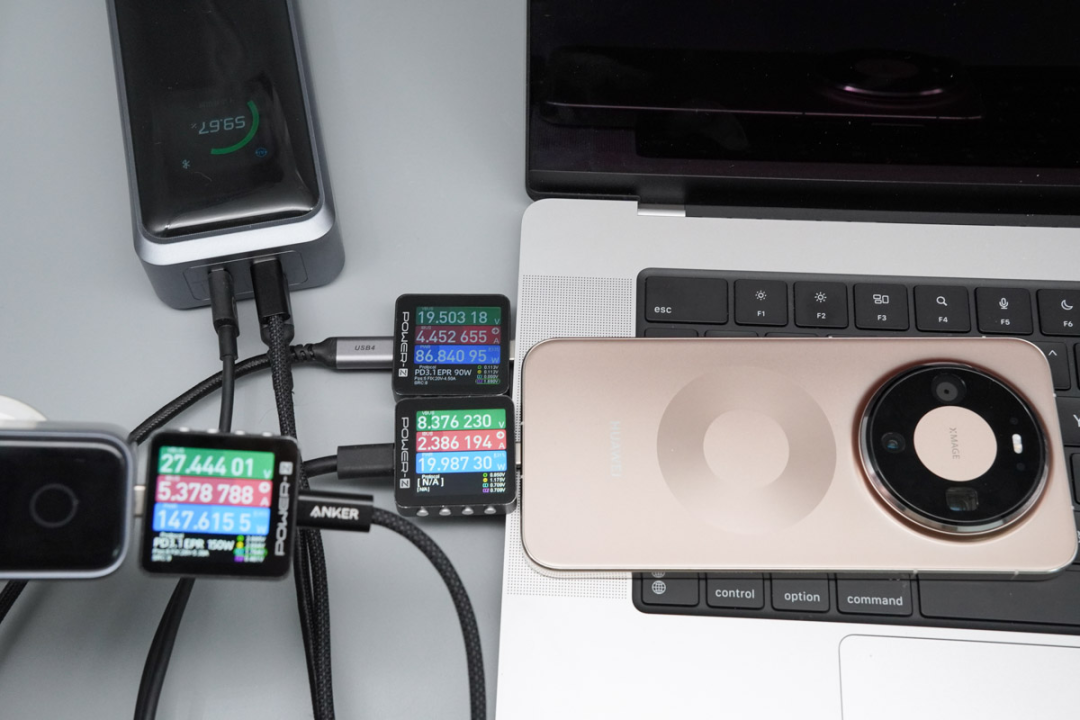
Case A
- Input: 27.44V 5.38A 147.62W (PD3.1 EPR 150W)
- Output: 19.99W to a phone, 87W to a laptop, total ≈ 107W
- Difference: 147.62W − 107W = 40.62W
This remaining power is used to charge the power bank itself, which is normal behavior.
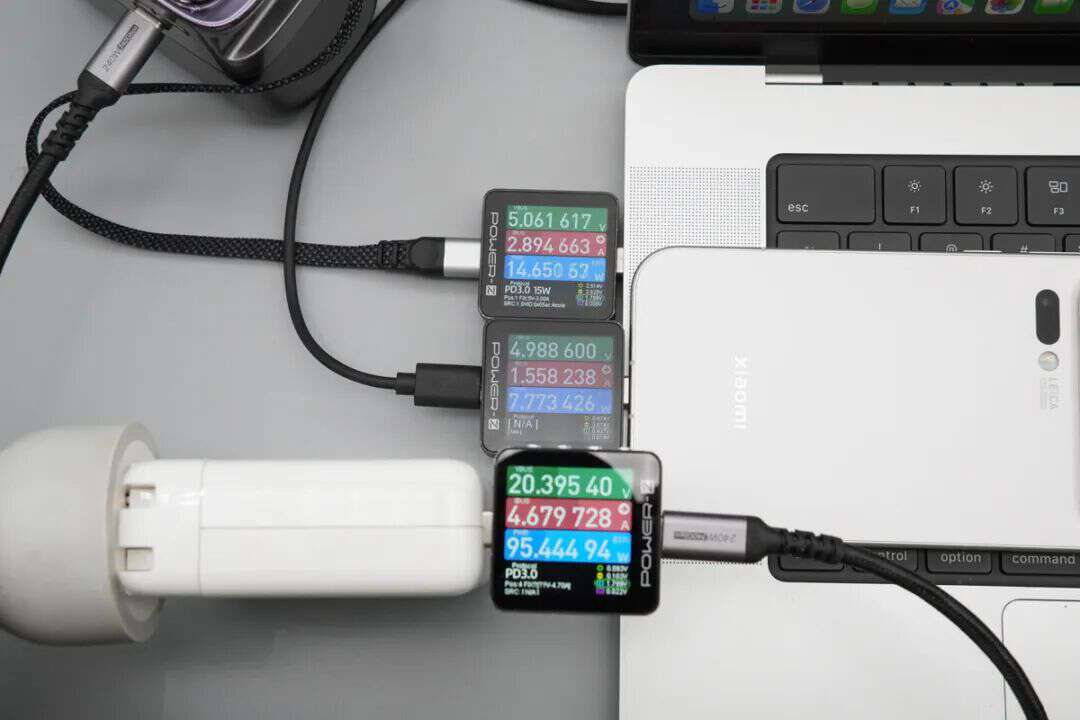
Case B
- Input: 20.39V 4.67A 95.44W (PD3.0 100W)
- Output: 7.77W to a phone, 14.65W to a laptop, total ≈ 22.42W
- Difference: 95.44W − 22.42W = 73.02W
This remaining power is also used for charging the power bank.
Scenario 2: Battery-Assisted Discharge (Input < Output)
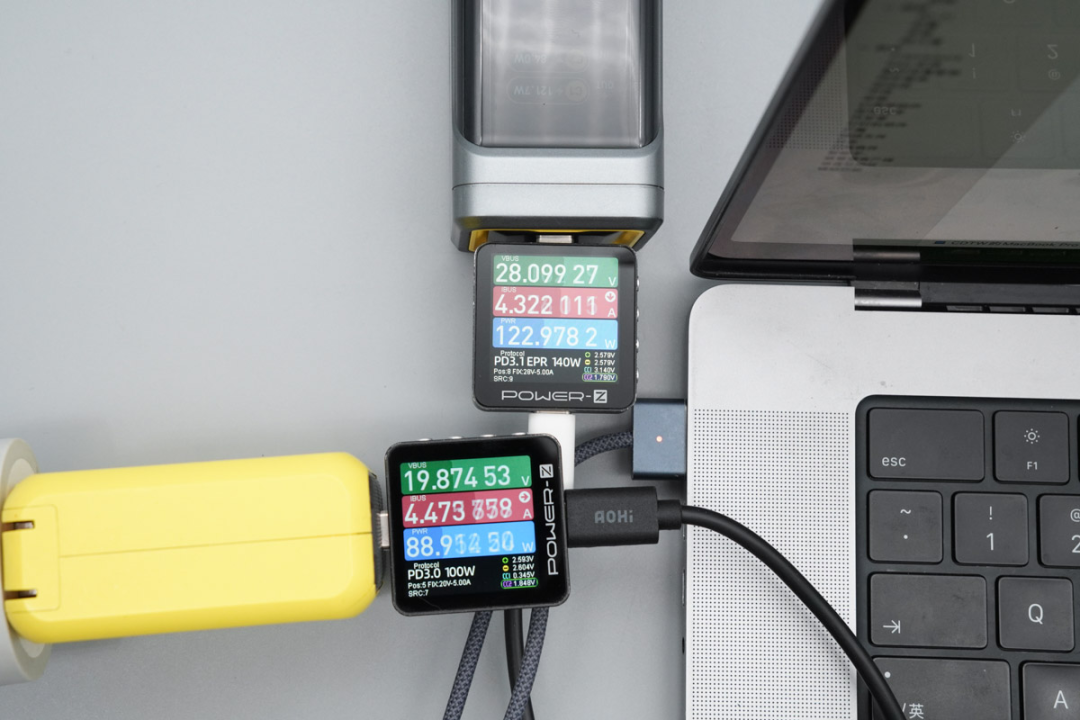
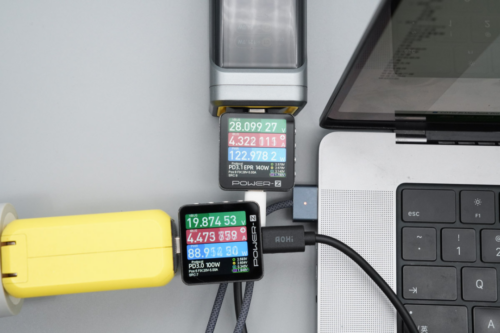
- Input: 19.87V 4.47A 88.91W (PD3.0 100W)
- Output: 122.97W to a laptop
Difference: 88.91W − 122.97W = −34.06W
This indicates that the charger alone cannot meet the load demand. In this case, the power bank battery also discharges to support the output together with the input power. Although this consumes battery energy, it ensures stable high-power delivery to the device.
5. Notes
- Use certified high-power cables that support the maximum power of the device to avoid inaccurate results caused by power limitations.
- Monitor the temperature of the power bank during testing. High temperatures may trigger power throttling and reduce output. Testing is recommended under room temperature conditions.
- All test data in this article are for reference only.
Related Articles:
1. Major Update on V.2.0.0! | The New Software Version of ChargerLAB POWER-Z KM003C
2. V.2.0.1 | The New Software Version of ChargerLAB POWER-Z KM003C
3. Major Update! ChargerLAB POWER-Z KM003C Gains Another Powerful New Feature