
Introduction
This edition of our teardown series features the LITEON PS-2852-1ADU, a high-performance 8500W server power supply designed for demanding data center environments. With a 200–277V AC input and a steady 51.5V/165A output, it also handles standby needs via a 12V/0.84A rail. The unit’s industrial design includes integrated handles and status LEDs, housed in a streamlined, long-form chassis.
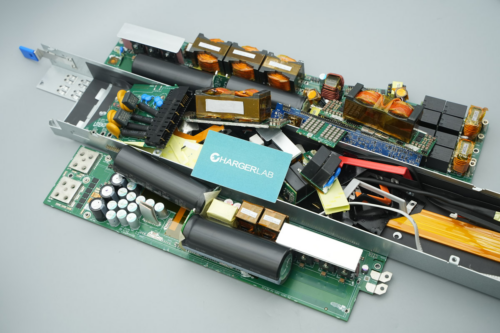
Under the hood, LITEON employs a high-efficiency architecture featuring a three-phase interleaved totem-pole PFC combined with a two-phase interleaved full-bridge LLC and synchronous rectification. The component list is equally impressive, featuring advanced controllers from TI and power MOSFETs from industry leaders Wolfspeed SiC and Infineon. Read on as we break down the engineering and components behind this massive 8500W power solution.
Product Appearance
The LITEON SiC server power supply features an elongated chassis design, constructed with a galvanized steel enclosure and a product label affixed to the front panel.
The front of the chassis features a cut-out design to accommodate the cooling fan, thereby reducing the overall thickness. The casing is secured with screws and incorporates spring contacts for grounding.
Power Supply Label Specs:
Model: PS-2852-1ADU
Input: 200–208V~, 35A, 50/60Hz | Output: +51.5V ⎓ 116.5A, +12VSB ⎓ 0.84A | Power: 6000W
Input: 208–220V~, 35A, 50/60Hz | Output: +51.5V ⎓ 133.98A, +12VSB ⎓ 0.84A | Power: 6900W
Input: 220–230V~, 35A, 50/60Hz | Output: +51.5V ⎓ 141.75A, +12VSB ⎓ 0.84A | Power: 7300W
Input: 230–240V~, 35A, 50/60Hz | Output: +51.5V ⎓ 147.57A, +12VSB ⎓ 0.84A | Power: 7600W
Input: 240–277V~, 35A, 50/60Hz | Output: +51.5V ⎓ 155.34A, +12VSB ⎓ 0.84A | Power: 8000W
Input: 277V~, 35A, 50/60Hz | Output: +51.5V ⎓ 165A, +12VSB ⎓ 0.84A | Power: 8500W
The side of the chassis is equipped with a locking latch, grounding springs, and alignment pins.
The locking latch on the side of the chassis.
The side of the chassis is equipped with grounding springs.
The alignment pin on the side of the chassis.
The back of the chassis features mounting screw holes.
The exterior of the power supply is equipped with a cooling fan, a mounting handle, and LED indicators.
The serial number label and LED indicators.
The input connector is located at the top of the rear panel, while the output connector is positioned at the bottom.
The output connector.
The length of the PSU is about 850mm (33.465 inches).
The width of the PSU is about 81.4mm (3.205 inches).
The thickness of the PSU is about 40.3mm (1.587 inches).
The weight is about 5.3kg (186.95 oz).
Teardown
With the exterior review of the LITEON server power supply complete, it is time to open it up. Let's dive into the teardown to explore the internal design and engineering choices.
First, remove the retaining screws and the mounting handle. Then, open the power supply enclosure, which is internally lined with Mylar insulation sheets.
The PCBA is secured within the enclosure using screws.
The front of the power supply is equipped with a cooling fan and copper busbars for electrical connection.
The left side houses the high-voltage filter caps and the PFC boost choke.
The switching MOSFETs in the center section are equipped with dedicated heatsinks.
On the right, the transformer is connected via soldered copper sheets, and the input PCB is covered with Mylar insulation.
The two ends of the copper busbar are secured with screws.
The LED indicator PCB is connected via wiring.
The control PCB is connected via a ribbon cable.
The PCBA modules are interconnected and secured using screws.
The communication terminals on the input PCB are connected via header pins.
Remove the retaining screws and detach the copper busbars from the input end.
The copper busbar is utilized for the input connection.
Remove the input PCB and the output connector.
The positive and negative output connectors are secured using screws.
The connection terminals of the rear output connector are gold-plated.
Remove the retaining screws and extract the PCBA. The PFC is located at the bottom of the enclosure, while the LLC is positioned at the top.
The input is connected via an elongated PCB.
The surface of the PCB is reinforced with adhesive tape to enhance insulation.
The PCB integrates copper busbars internally, with connection terminals provided on both sides.
The input PCB front side, the varistor and gas discharge tube are insulated with tape.
Remove the insulating tape. The gas discharge tube, fuse, and Y-caps are sleeved with heat-shrink tubing for enhanced insulation.
The back of the PCB features copper busbars to enhance current-carrying capacity.
The fuse is rated at 45A 500V and is protected by a heat-shrink insulating sleeve.
The X2 safety cap is from SCC, 0.15μF.
The blue Y-cap is from WTC, model AH222M.
The yellow varistor, model TVR14621, is utilized for overvoltage surge suppression.
The glass gas discharge tube is utilized for overvoltage surge suppression.
The NTC thermistor used for temperature detection.
The diode is from Vishay, marked S123, model SS12P3L. It is a Schottky diode rated at 30V 12A, housed in a TO-277A package.
Here are the MLCCs.
The front of the PFC module. The AC input end is on the right, equipped with a common-mode choke, switching relay, soft-start PCB, and auxiliary power supply PCB. The PFC choke is positioned in the upper center, with the high-voltage filter cap below it. The control PCB is on the upper left. A copper shield covers the area, underneath which the driver and PFC switching MOSFETs are installed.
The back of the PFC module is populated with the PFC switching MOSFETs, diodes, and current sensing IC. The PCB features a cutout directly beneath the high-voltage cap to reduce the overall assembly profile.
Desolder and remove the high-voltage filter cap, auxiliary power PCB, soft-start PCB, and control PCB to proceed with the disassembly.
The two sets of input ends are arranged in a staggered vertical layout to facilitate connection with the busbars.
The terminal posts are soldered to the PCBA. A common-mode choke is positioned behind them, with gas discharge tubes located on both sides of the choke.
The relay is utilized for switching between the dual input sources.
The switching relay is from Hongfa, model HF179-40W/12-H1TF. It is a compact, high-power relay with a contact current rating of 40A and a coil voltage of 12V. The two relays are connected in series.
An insulating PCB is soldered to the side of the relay.
The front of the soft-start PCB is equipped with a startup resistor, an IGBT, a relay, an X2 safety cap, and a Y-cap.
The back of the PCB is insulated with high-temperature adhesive tape.
Remove the startup resistor to inspect the component part numbers on the PCB.
Two IGBTs are mounted on both sides of the heatsink.
The IGBT is from Infineon, marked H40MR5, model IHW40N120R5. It is a discrete IGBT featuring an anti-parallel diode, with a rating of 1200V/40A, and is housed in a TO-247 package.
Another one shares the same model.
The resistor is insulated with a heat-shrink tube.
The cement resistor is specified at 1.3Ω.
The startup resistor is encapsulated in heat-shrink tubing for electrical insulation.
The resistor is soldered onto a vertical PCB, with the back of it insulated using adhesive tape.
The startup resistor, spec 17Ω.
The startup relay is from Hongfa, model HF161-40/12HTF. It is a compact, high-power relay with a current rating of 40A and a coil voltage of 12V.
The SMD MLCCs.
The TVS is from TSC, marked LEJ, model P6SMB18AH. It features a reverse standoff voltage of 15.3V, a breakdown voltage of 17.1V, and a peak pulse power rating of 600W. The device is AEC-Q101 qualified and housed in an SMB package.
The two blue Y-caps are from WTC, model AH332M.
The X2 safety cap is from HJC, 1.5μF.
The LTV-1007 optocoupler by LITEON is utilized for voltage sensing applications.
The gate driver is from TI, model UCC27511. It is a single-channel, high-speed gate driver with split outputs, designed for driving IGBTs and housed in an SOT-23 package.
The common-mode choke is wound with enameled wire, the magnetic core is insulated with tape, and a bakelite board is placed at the bottom for insulation.
The Y-cap and X2 safety cap are soldered onto the vertical PCB.
The back of the PCB is insulated with high-temperature adhesive tape.
Two blue Y-caps are from WTC, model AH332M.
The X2 safety cap is from HJC, 1.5μF.
The PFC MOSFET is mounted on a heatsink, with power transformers positioned on both sides.
Another PFC MOSFET is mounted on the opposite side of the heatsink.
The PFC MOSFET is from Wolfspeed, model C3M0045065K. It is a SiC MOSFET, 650V and 45mΩ, and is housed in a TO-247-4 package.
Three additional MOSFETs of the same model are mounted on the opposite side of the heatsink, forming a totem-pole PFC fast half-bridge.
Three isolated gate drivers are provided, corresponding to the six MOSFETs.
The gate driver is from TI, model UCC21520A. It is a dual-channel isolated gate driver featuring 4A source and 6A sink current, 5.7kVrms isolation capability, and support for 3-18V input and 25V drive voltage. It includes UVLO protection and is housed in an SOIC-16 package.
The slow half-bridge MOSFETs are from Infineon, marked 60R022S7, model IPT60R022S7. These are CoolMOS S7 series devices, 600V and 22mΩ, housed in an HSOF-8 package.
The rectifier diodes are from TSC, model S15MC, 1000V and 15A, and are housed in an SMC package.
Other rectifier diodes of the same model is mounted on the opposite side.
They share the same model.
The gate driver is from TI, model UCC27424. It is a dual-channel low-side gate driver featuring 4A peak output current and is housed in an SOIC-8 package.
The matching transformer.
Another gate driver shares the same model.
The matching transformer.
The PFC chokes are wound with Litz wire and are insulated at the bottom with a bakelite.
Three current sensing ICs are provided, corresponding to the three PFC chokes.
The current sensing IC is from Allegro, model ACS733. It is a 1MHz bandwidth current sensor utilizing differential Hall-effect sensing, featuring 3600Vrms isolation, and is housed in an SOIC-16 package.
The transistor is from Nexperia, model PBSS4350Z. It is an NPN transistor rated at 50V and 3A, housed in an SOT-223 package.
The voltage divider resistors used for voltage sensing.
The high-voltage filter cap is insulated with adhesive tape, and a PCB is soldered to the bottom for interconnection.
The high-voltage filter cap is from Elite, belonging to the PI series of compact electrolytic capacitors, spec 1870μF/475V.
Another one, spec 1430μF475V.
The high-voltage filter cap, 1190μF475V.
The diode is from DIODES, model B260A. It is rated at 60V and 2A, and is housed in an SMA package.
The step-down chip is from TI, marked NAYS, model TPS560430. It is a synchronous step-down converter supporting a 4V–36V input voltage range, 0.6A output current, and is housed in a SOT-23 package.
The step-down choke, 47μH.
The transistor is from by Nexperia, model PBSS5350Z. It is a PNP transistor rated at 50V and 3A, housed in an SOT-223 package.
Here are the MLCCs.
The three diodes, model B260A.
The transistor is from Nexperia, model PBSS5350Z.
The three diodes, model B260A.
The filtering cap is from NCC, belonging to the PSG series of conductive polymer aluminum solid electrolytic caps, spec 220μF/25V.
The two filtering caps are from NCC, spec 35V 330μF.
The blue Y-cap is from WTC, model AH102M.
The PFC output connection terminals.
The PFC control PCB features an integrated real-time MCU, crystal oscillator, and memory on its outer edge.
A synchronous step-down chip is located on the back.
The real-time MCU is from TI, model TMS320F28P650SH. It features an integrated C2000 32-bit MCU architecture, incorporating a C28x DSP, a CLA CPU, and a 64-bit FPU. The device includes 768KB of Flash and 244KB of SRAM, integrates a 16-bit ADC, and is housed in an HTQFP-100 package.
The external 20.0 MHz crystal oscillator used for the MCU.
The memory is from MICROCHIP, model AT25512, marked 5F. It provides 64KB of storage, supports an operating voltage range of 1.8V to 5.5V, and is housed in an 8-lead TSSOP package.
The step-down chip is from TI, model TPS560430.
The step-down choke, 47μH.
The chip, marked ZFS2.
The SMD choke, 10μH.
Here are the MLCCs.
The socket used for connecting the LLC control PCB is from Amphenol.
The two auxiliary power supply PCBs are identical, each corresponding to a separate input channel.
The auxiliary power supply PCB, the front side integrates a bridge rectifier, an NTC thermistor, a high-voltage filter cap, a transformer, and a Schottky diode. The right side hosts a step-down chip, a voltage regulator, and an optocoupler.
The back of the PCB features a voltage regulator, an isolation amplifier, an auxiliary power supply control chip, and a Schottky diode.
The rectifier bridge is from TSC, model ABS20M, spec 2A and 1000V, and comes in an ABS package.
The SCK102 NTC thermistor is utilized to suppress inrush current during the power-on sequence.
The high-voltage filter cap is from Rubycon, belonging to the HXW series of electrolytic caps, spec 500V/33μF. The top of it is insulated with high-temperature adhesive tape.
The auxiliary power supply control chip is from Infineon, model ICE5QR0680BG. It is a 5th-generation Quasi-Resonant integrated power IC, featuring an integrated controller and an 800V CoolMOS. It supports a wide input voltage range with an output power capability of up to 42W, housed in a DSO-12 package.
The filtering cap used for powering the auxiliary power supply control chip is rated at 47μF/50V.
The TVS is from Littelfuse, model P6SMB180A. It features a reverse standoff voltage of 154V, a breakdown voltage of 171V, and a peak pulse power rating of 600W, housed in an SMB package.
The transformer core is insulated by wrapping it with insulating tape.
The Everlight EL1017 optocoupler is utilized for output voltage sensing and feedback regulation.
The diode is from DIODES, model SBR10U200P5, marked S10U200, 200V and 10A, housed in a PowerDI5 package.
Here are the MLCCs.
Another diode shares the same model.
Here are the MLCCs.
MLCCs are positioned adjacent to the pin headers.
The voltage regulator is from ST, marked LD33, model LD1117S33TR. It supports an input voltage of up to 15V, provides a fixed 3.3V output, delivers a maximum output current of 800mA, and is housed in an SOT-223 package.
The step-down chip is from TI, model TPS560430.
The step-down choke, 47μH.
The voltage regulator is from TI, model TPS70950, marked SDH. This is a low-dropout regulator featuring reverse current protection and an enable function, supporting an input voltage up to 30V and an output current of 150mA, housed in an SOT-23 package.
The isolation amplifier is from TI, model AMC1301. It is a precision reinforced isolated amplifier that supports an input voltage range of ±250mV and an operating temperature range of -40°C to 125°C, housed in a SOIC-8 package.
The voltage divider resistors used for sensing the system voltage.
The front of the LLC module, the left side features the input terminals, high-voltage filter caps, and the heatsink for the switching MOSFETs. The right side accommodates the resonant cap PCB, the resonant choke, and the standby power transformer. Centrally located is the main LLC transformer, which is integrated with the synchronous rectifier PCB. Further to the right are the secondary output filtering caps and additional heatsinks.
The back of the LLC module integrates the isolation driver and the current sensing IC. The central area accommodates the standby power control chip and the synchronous rectifier MOSFETs, while the right section features the current sense resistor and output control MOSFETs.
Desolder and remove the high-voltage filter cap, control PCB, resonant cap PCB, transformer, synchronous rectifier PCB, and the heatsink for the output control MOSFET to proceed with the disassembly.
The high-voltage filter cap is insulated with adhesive tape.
The cap is connected to a small PCB via side-mounted pins and is insulated using a Mylar sheet.
The cap is connected via soldering.
The filtering caps, spec 1430 μF 475 V, with a total capacitance of 5920 μF.
A heatsink secures the full-bridge LLC switching MOSFETs.
The back is slotted and insulated by inserting a Mylar sheet.
The LLC switching MOSFET is from Infineon, marked 60R031F7, model IPW60R031CFD7. Belonging to the CoolMOS CFD7 series, NMOS, 650V and 31mΩ, housed in a TO-247-3 package.
Four switching MOSFETs of the same model are mounted on the other side of the heatsink for interleaved full-bridge LLC conversion.
The driver is from TI, model UCC21520A, the same model used for the PFC MOSFET driver.
A total of four MOSFETs are utilized to implement a two-phase interleaved full-bridge LLC converter application.
The ES1J diode and the B260A diode.
The filtering cap is from Panasonic, part of the SVPK series conductive polymer aluminum solid electrolytic cap family. It is rated at 47μF/35V and features an operating temperature tolerance of 125°C.
Here are the MLCCs.
The current sensor is from Allegro, model CT433-HSWF65MR. It features 5kV reinforced isolation, supports bidirectional current sensing up to 65A, operates within a temperature range of -40°C to 125°C, and is housed in a 16-lead SOICW package.
Two resonant chokes are insulated by wrapping them with high-temperature adhesive tape.
The resonant cap PCB is insulated by wrapping it with high-temperature adhesive tape.
The front of the PCB features NPO resonant caps.
The back of the PCB features reserved footprints for unpopulated components.
The transformer is connected to the synchronous rectifier PCB via soldering.
Copper busbars are soldered to the top of the PCB for connection.
The bottom of the PCB is equipped with connection busbars and header pins.
The transformer is connected to the synchronous rectifier PCB via soldering.
Desolder the connections to separate the transformer from the synchronous rectifier PCB.
The transformer core is insulated with adhesive tape. The primary winding is constructed using Litz wire, while the secondary winding utilizes soldered copper foils.
The top of the synchronous rectifier PCB is populated with MLCCs and synchronous rectifier MOSFETs.
The back of the synchronous rectifier PCB is populated with synchronous rectifier MOSFETs and gate drivers.
The synchronous rectifier MOSFET is from Infineon, marked 014N8N6, model ISC014N08NM6, NMOS, 80V and 1.45 mΩ, housed in a TSON-8 package.
Four synchronous rectifier MOSFETs of the same model are located in the center.
Two synchronous rectifier MOSFETs of the same model are located on the right.
The thermistor used for temperature sensing.
Here are the MLCCs.
The MLCCs.
Four synchronous rectifier MOSFETs of the same model are located on the left.
Eight synchronous rectifier MOSFETs of the same model are located in the center.
Four synchronous rectifier MOSFETs of the same model are located on the right.
The gate driver is from TI, model UCC21225A. It is a dual-channel isolated driver featuring 2.5kV isolation, 4A source and 6A sink peak currents, and is compatible with GaN, IGBT, MOSFET, and SiC applications. The device is housed in an LGA-13 package.
The driver located in the middle on the left.
The driver located in the middle on the right.
The drivers on the right, a total of four units of the same model are used.
High-temperature adhesive tape is applied to the base of the transformer for electrical insulation.
The output filter capacitor is from Lelon, belonging to the HBS series of conductive polymer hybrid aluminum electrolytic caps. It is rated at 220μF/63V and provides a rated life of 4,000 hours at 125°C.
The filter electrolytic cap is from Rubycon, belonging to the ZLJ series of long-life electrolytic caps, spec 820μF/63V.
The current sense resistor and output control MOSFETs are covered by a heatsink, with thermal pads applied to ensure efficient heat transfer.
The current sense resistor, marked L20.
The output control MOSFET is the Infineon ISC014N08NM6, which is the same model as the synchronous rectifier MOSFET.
Two current sense resistor, marked L20, are also located on the back of the PCB.
Six output control MOSFETs of the same model are located on the back of the PCB.
The power supply's positive and negative output connectors.
The standby power control chip is located beneath the shielding copper plate.
The standby power control chip is from PI, model INN3690C, specially the InnoSwitch3-EP series. It integrates a 900V PowiGaN switch, a multi-mode quasi-resonant flyback controller, secondary-side sensing, and a synchronous rectification driver. It utilizes FluxLink feedback technology, supports an 85W output with wide input voltage range, and is housed in an InSOP-24D package.
Here is the info about the PI INN3690C.
The standby power transformer is insulated with wrapping tape and features a Bakelite at the base for additional electrical isolation.
The synchronous rectifier MOSFET is from Infineon, model BSC110N15NS5, marked 110N15NS, NMOS, 150V and 11mΩ, housed in a TDSON-8 package.
The filtering cap is from Lelon, belonging to the OVG series of conductive polymer aluminum solid electrolytic caps. It is rated at 120μF/25V and offers an operational life of 15,000 hours.
Two filtering caps are from Nichicon, belonging to the FPCAP series of conductive polymer aluminum solid electrolytic caps, are utilized, spec 1500μF/16V.
The step-down chip is from TI, model TPS560430.
The step-down choke, 47μH.
The filtering choke, 1μH.
A 10mΩ current sense resistor is utilized for output current monitoring.
The current sensing IC is from TI, model INA199B3, marked SHE. It is a 26V, bidirectional, zero-drift current sense amplifier housed in a compact SC70 package.
The power control MOSFET is from Infineon, model BSC010NE2LS, marked 010NE2LS, NMOS, 25V and 1mΩ, housed in a TDSON-8 package.
The transistor is from Nexperia, model PBSS4112PAN, marked 2R. It is a dual NPN/PNP transistor rated for 120V and 1A, housed in a DFN2020-6 package.
The diode is from Vishay, model V12PM12, marked 12M12. It is a Trench MOS Barrier Schottky rectifier rated at 120V and 12A, housed in a compact TO-277A package.
Here are the MLCCs.
The 10mΩ SMD resistor.
The pin header connector used for communication interfaces on the PCB.
A copper shielding plate is installed on the outer side of the control PCB to mitigate electromagnetic interference.
The control PCB is also equipped with a copper shielding plate on the inner side.
Remove the shielding copper plates from both sides of the control PCB.
The outer side of the control PCB accommodates the operational amplifier, current sensing IC, real-time MCU, I/O expander, power control MOSFET, and isolated communication IC.
The inner side of the control PCB incorporates a CAN transceiver, memory, gate drivers, an isolation transformer, rectifier MOSFETs, and filtering caps.
The real-time MCU is from TI, model TMS320F28P650SH.
The external 20.0 MHz crystal oscillator providing the clock signal for the MCU.
The memory is from ST, model M24512-RDW6TP, marked 412R8, with 64KB of capacity and versatile 1.7-5.5V operation, housed in a TSSOP8 package.
The I/O expander is from TI, model TCA9539-Q1, marked TCA539Q. It is an automotive-grade, low-voltage, 16-bit I2C and SMBus I/O expander featuring interrupt output, reset functionality, and configuration registers, housed in a TSSOP-16 package.
The operational amplifier is from TI, model OPA4191. It is a quad, low-power, precision operational amplifier featuring RRIO capabilities, rated for operation across a temperature range of -40°C to 125°C, and housed in a TSSOP-14 package.
The current sense IC is from TI, model INA240, marked I240A2. It is a high-precision, bidirectional, current sense amplifier featuring enhanced PWM rejection, supporting a wide common-mode voltage range of -4V to 80V, housed in a TSSOP-8 package.
The operational amplifier is from TI, model OPA172, marked OUWQ. It is a single-supply, RRO operational amplifier housed in a compact SOT-23 package.
The voltage regulator is from TI, model TPS70950.
The chip, marked ZFS2.
The filtering caps, 330μF16V.
The filtering caps, 220μF16V.
The power control MOSFET is from Infineon, model BSC010NE2LS.
The driver is from TI, model UCC27424.
The transformer is insulating with adhesive tape.
The rectifier bridge configuration consists of four B260A Schottky diodes.
The filtering cap, 47μF35V.
The isolated communication IC is from TI, model ISO1042. It is a galvanically isolated CAN transceiver compliant with ISO 11898-2:2016 and ISO 11898-5:2007 physical layer standards. It supports data rates of 1 Mbps (CAN) and 5 Mbps (CAN FD), housed in a compact 8-SOIC package.
The isolated communication IC is from TI, model ISO7741. It is a high-speed, quad-channel reinforced digital isolator featuring a 3/1 channel configuration (3 forward, 1 reverse). It supports data rates up to 100 Mbps and operates within a temperature range of -55°C to 125°C, housed in a 16-pin SOIC package.
The CAN transceiver is from NXP, model TJA1042T/3. It is a high-speed CAN transceiver featuring a low-power standby mode and remote wake-up capability, housed in an SO8 package.
The two B260A Schottky diodes.
The Vishay SS12P3L diodes.
Here are the MLCCs.
The cooling fan and the LED indicator PCB are connected via a connector.
The step-down converter PCB is engineered with thermal pads for heat dissipation and copper shielding, and the solid caps are insulated with adhesive tape
A shielding copper plate is provided on the back of the PCB.
The left side of the PCB features a step-down control chip, the center section houses the synchronous step-down switching MOSFETs, a current sense resistor, and filtering caps, and the right side contains the step-down choke.
The fuse and diodes are mounted on the back of the PCB.
The step-down control chip is from TI, model LM5117. It is a synchronous buck controller operating with an input voltage range of 5.5V to 65V, utilizing peak current-mode control. Key features include an analog current monitor, programmable current limit, programmable soft-start and tracking, programmable input UVLO, and a programmable switching bias regulator, all housed in an HTSSOP-20 package.
The synchronous step-down switching MOSFETs are from Infineon, model BSC021N08NS5, marked 021N08N, NMOS, 80V and 2.1 mΩ. The design employs a dual-high-side (right) and dual-low-side (left) configuration in a TSON-8-3 package, optimizing efficiency through parallel operation.
An 8 mΩ current sense resistor is employed for output current monitoring.
The step-down choke, 10μH.
The filtering caps, 220μF16V.
This TVS is from Littelfuse, marked NG, model SMBJ58A, features a reverse standoff voltage of 58V, and in an SMB package.
The diodes are the Vishay V12PM12.
A piece of foam is adhered to the front of the LED indicator PCB to block light.
A connector is located on the back of the PCB.
The SMD LED indicators.
The internal temperature sensor of the power supply.
The cooling fan is secured with a steel plate.
The cooling fan is from SUNON, model XG40561BX-1QA90-S9I, and operates on an input voltage of 12V.
Well, those are all components of the LITEON 8,500W SiC AI Server Power Supply (PS-2852-1ADU).
Summary of ChargerLAB
LITEON’s 8,500W AI server power supply (Model PS-2852-1ADU) is a high-performance solution for demanding data center environments. It operates on a 200-277V AC input, providing a robust 51.5V/165A main output alongside a 12V/0.84A standby rail. Engineered for reliability, the unit features an intelligent front-to-back airflow thermal management system.
The supply architecture leverages a sophisticated dual-PCBA design featuring three-phase interleaved totem-pole PFC and two-phase interleaved full-bridge LLC, combined with synchronous rectification. Designed for precision control, it incorporates TI’s TMS320F28P650SH real-time MCUs across its power stages. Premium components, including Wolfspeed SiC MOSFETs and Infineon power MOSFETs, drive industry-leading efficiency. Connectivity and safety are reinforced by TI’s isolation solutions (ISO1042, ISO7741, AMC1301) and high-precision current sensing from Allegro.
Power integrity is maintained by top-tier capacitors from Elite, Lelon, and Rubycon, while the standby circuit utilizes Power Integrations' advanced 900V PowiGan GaN technology. The compact, modular interior maximizes space and thermal dissipation for sustained high-power output.
Related Articles:
1. Teardown of the Delta 3000W SiC Server PSU (DPS-3000AB-22A)
2. PowerPi MP305B DC Power Supply Set to Launch on Amazon US — Efficient Power for All Scenarios
3. Teardown of the muRata’s 2000W Titanium-Rated SiC Server PSU