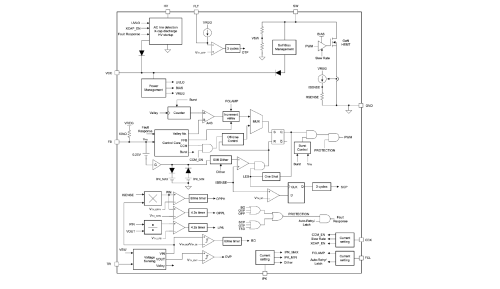
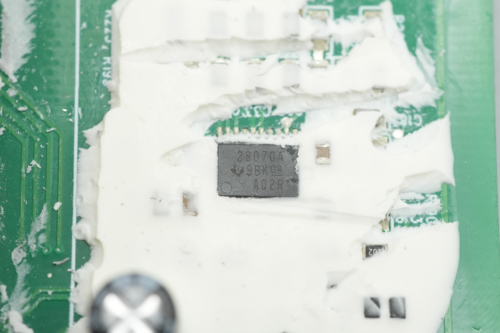

AI-driven server power demands are skyrocketing, pushing requirements from 3kW up to 30kW. Conventional PFC controllers, limited by a 30kHz frequency floor, have become a bottleneck for high-power IGBT systems, resulting in ripple and EMI issues. Texas Instruments (TI) is changing the game with the UCC28070A, a two-phase interleaved CCM PFC controller. By pushing the frequency range down to 10kHz, TI provides a rare, versatile solution that bridges the gap between legacy IGBTs and modern wide-bandgap (SiC/GaN) technologies, setting a new standard for AI power reliability and density.

The UCC28070A features a 180° interleaved architecture and proprietary current synthesis that slashes input/output ripple, allowing for smaller bus capacitors. Its ultra-wide 10kHz–300kHz frequency flexibility is a designer’s dream: optimize for IGBT switching efficiency at low frequencies or shrink inductors with SiC/GaN at higher frequencies. With 8-level voltage feedforward and advanced slew-rate correction, the IC maintains rock-solid bus output stability despite the wild load swings of AI GPUs. Plus, it scales seamlessly for 4-phase or 6-phase ultra-high-power designs, delivering oscillation-free performance and robust hardware protection even in extreme thermal environments.

The UCC28070A is a strategic win for AI power design. It harmonizes two competing design routes—IGBTs and SiC/GaN—to drive down BOM costs and power supply size. As AI infrastructure trends toward massive, high-density power architectures, TI’s integrated, wide-bandwidth PFC controller is set to become the backbone for future data centers, liquid-cooled supercomputers, and industrial AI, helping the industry win the power race with higher performance and tighter margins.
Related Articles:
1. Southchip SC8723: A High-Integration Solution for Compact Buck-Boost Power
2. iCM Chip Joins Tesla Supply Chain: A Milestone for China’s Semiconductor Industry
3. RUNXIN's GaN Chips Enter Philips Supply Chain