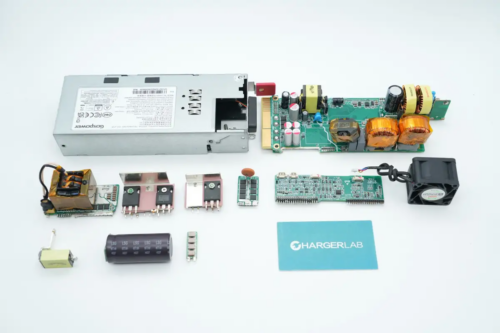
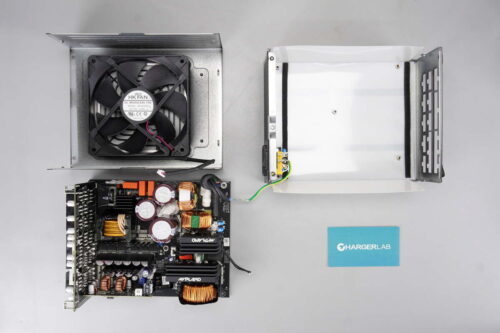

Introduction
This issue examines the Huntkey MVP P1600X Platinum Full Modular PC Power Supply. It has a rated output of 1600W and supports 115–240V AC input, providing a robust 12V output at 133A, with 5V and 3.3V outputs both rated at 30A. The unit features PCIe 5.1 connectors, supporting dual-CPU and multi-GPU configurations. The power supply utilizes a PFC+LLC+SR+DC-DC topology. Below, we take a closer look at its internal design and components.
Product Appearance
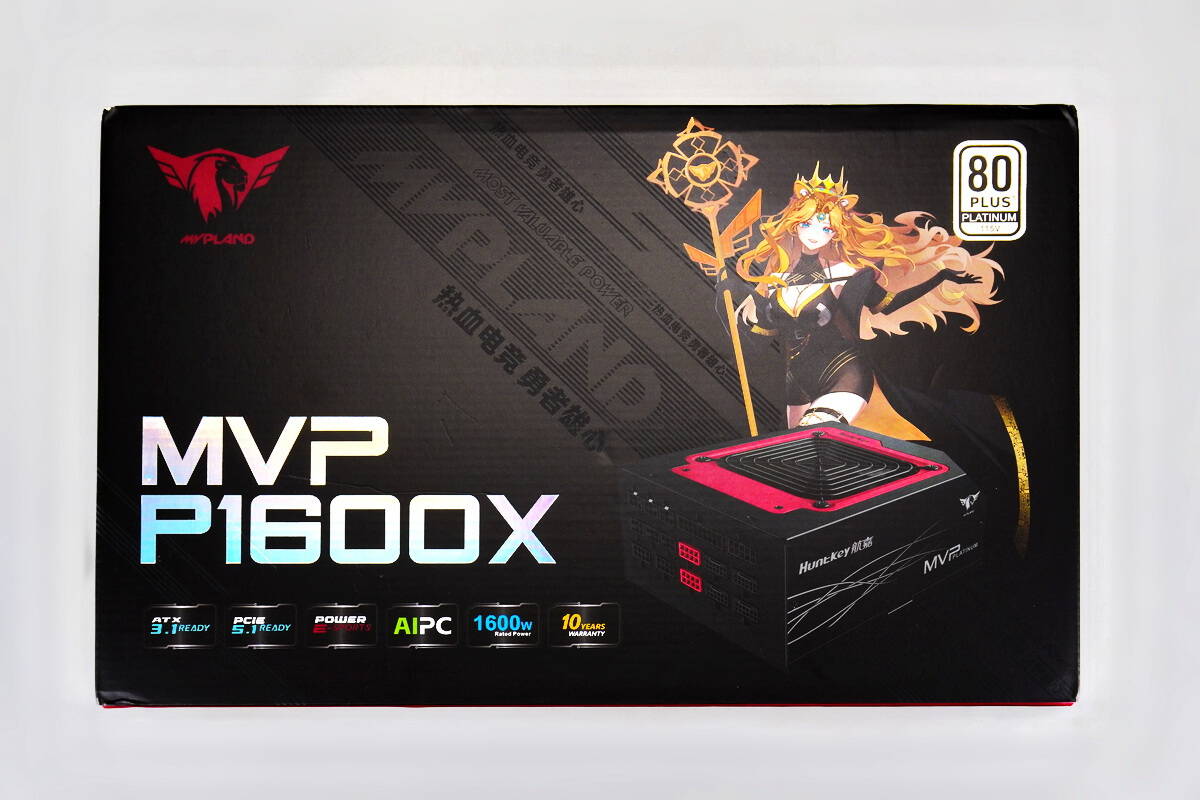
The packaging features the MVP P1600X branding, key selling points, 80 PLUS Platinum certification, and includes an image of the unit’s exterior.
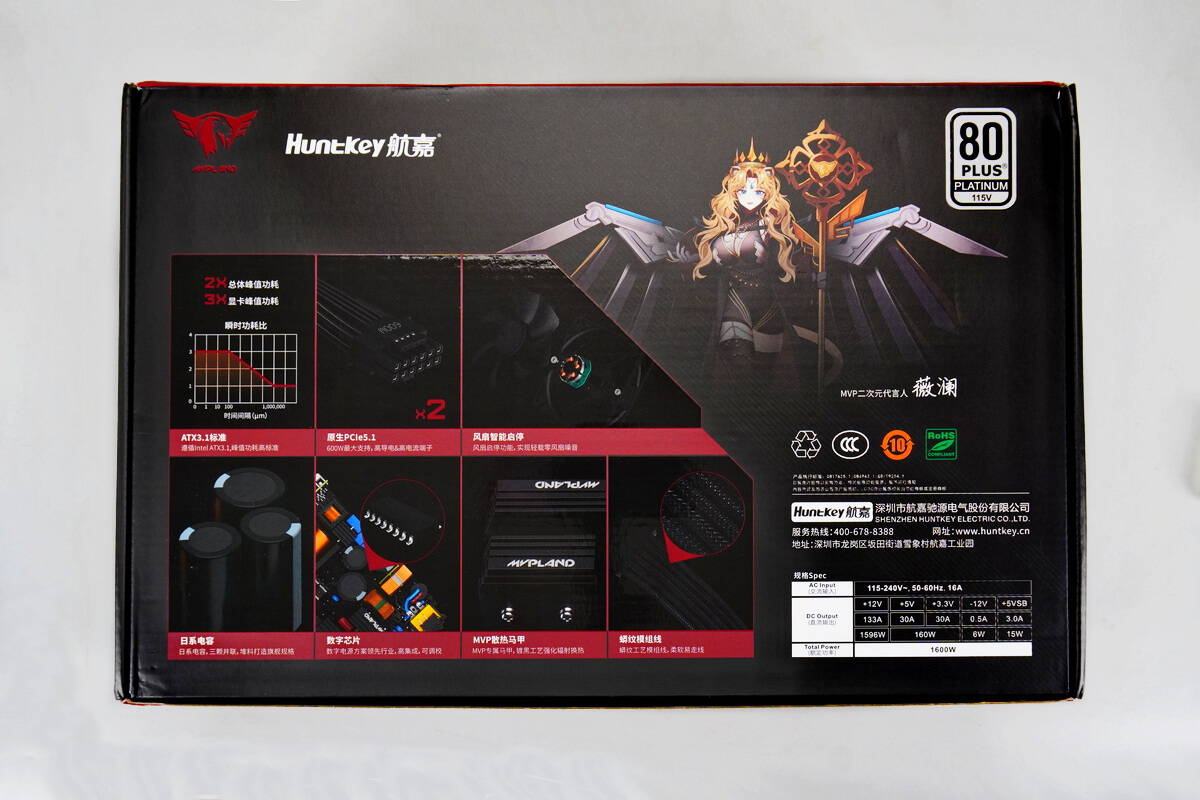
The back of the packaging features key selling points and manufacturer information.

Overview of the power supply and module cables.

The front fan is equipped with a protective grille.
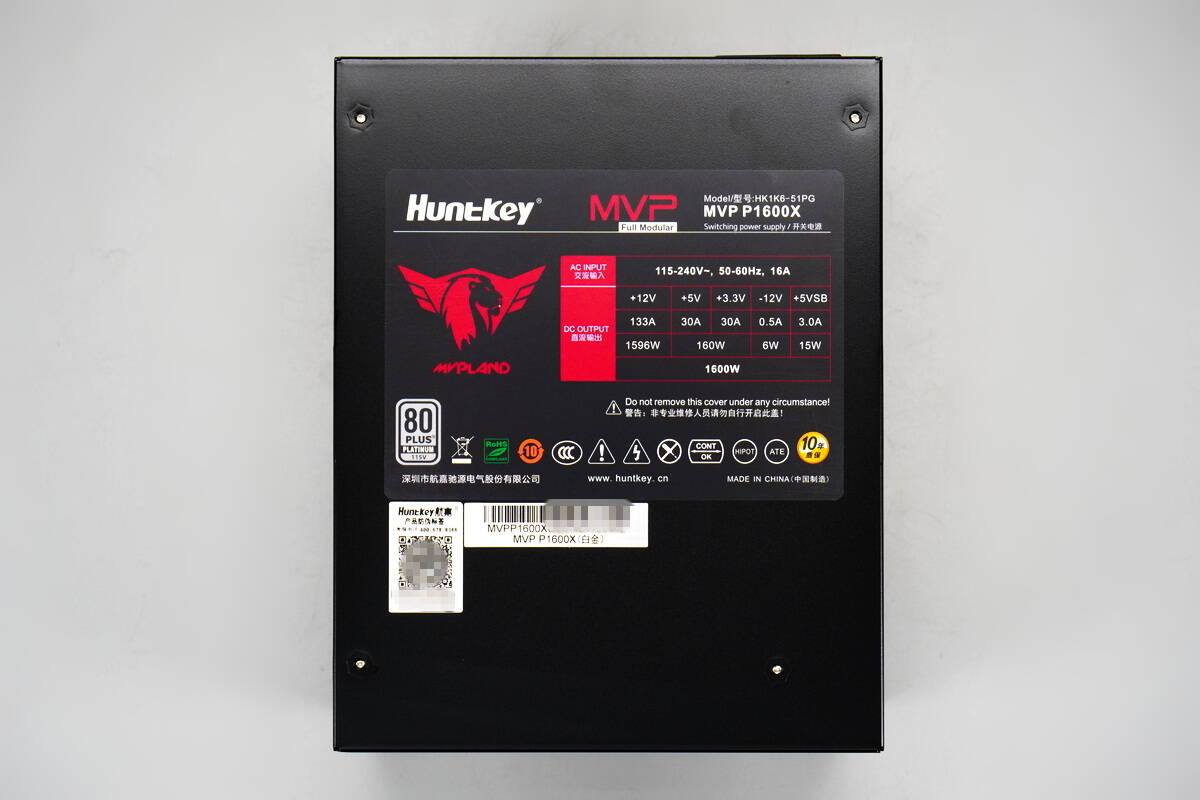
An information label is affixed to the back.
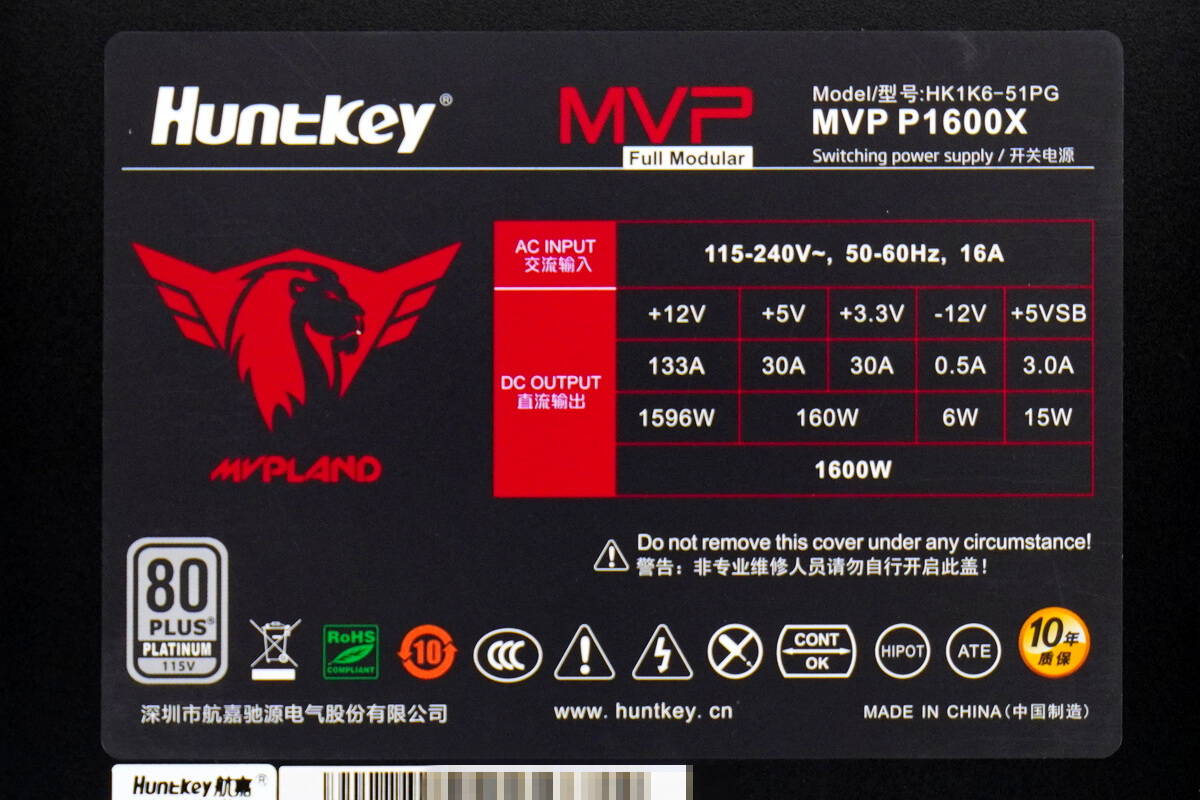
Model: HK1K6-51PG
AC Input: 115–240V~, 50–60Hz, 16A
DC Output: +12V ⎓ 133A, +5V ⎓ 30A, +3.3V ⎓ 30A, -12V ⎓ 0.5A, +5VSB ⎓ 3A
Rated Output Power: 1600W

The side features the Huntkey logo and MVP PLATINUM.
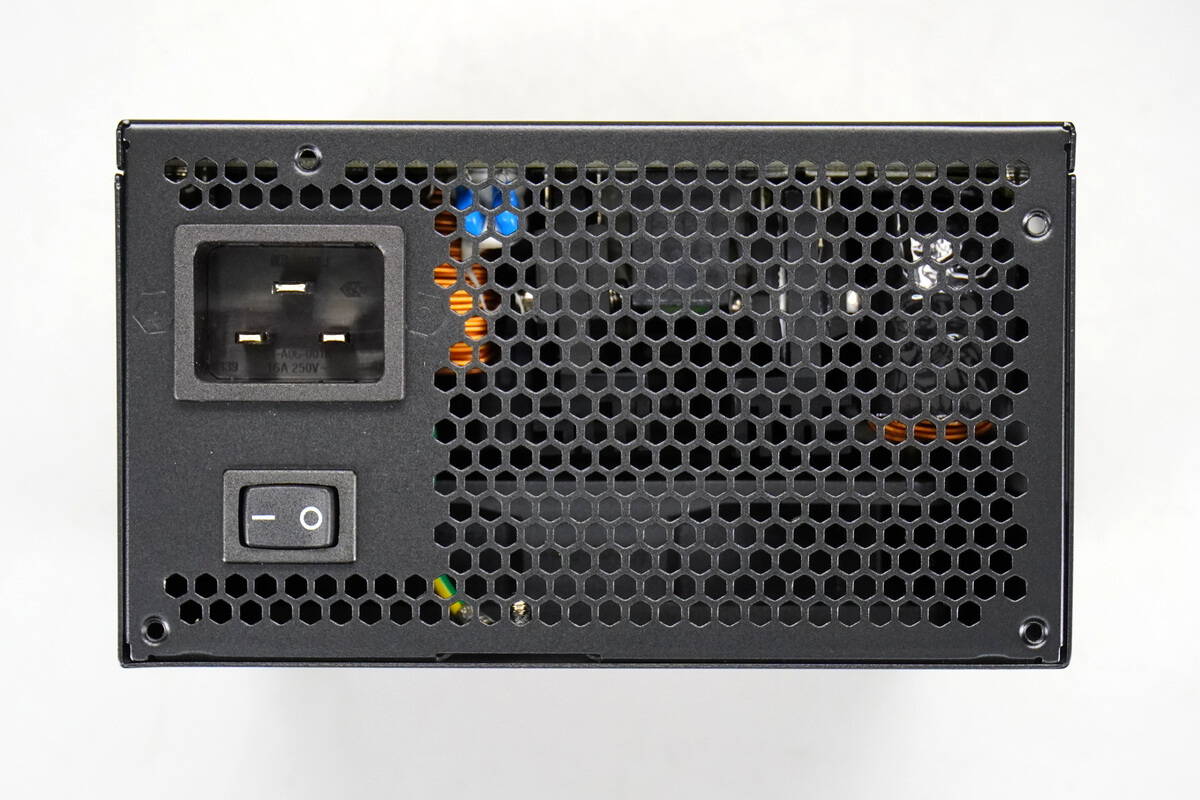
The input side uses a C20 socket and is equipped with a switch.

The output side has three rows of modular terminals, with the red connectors designated for graphics card (PCIe) power.

The length of the module is about 190 mm (7.48 inches).
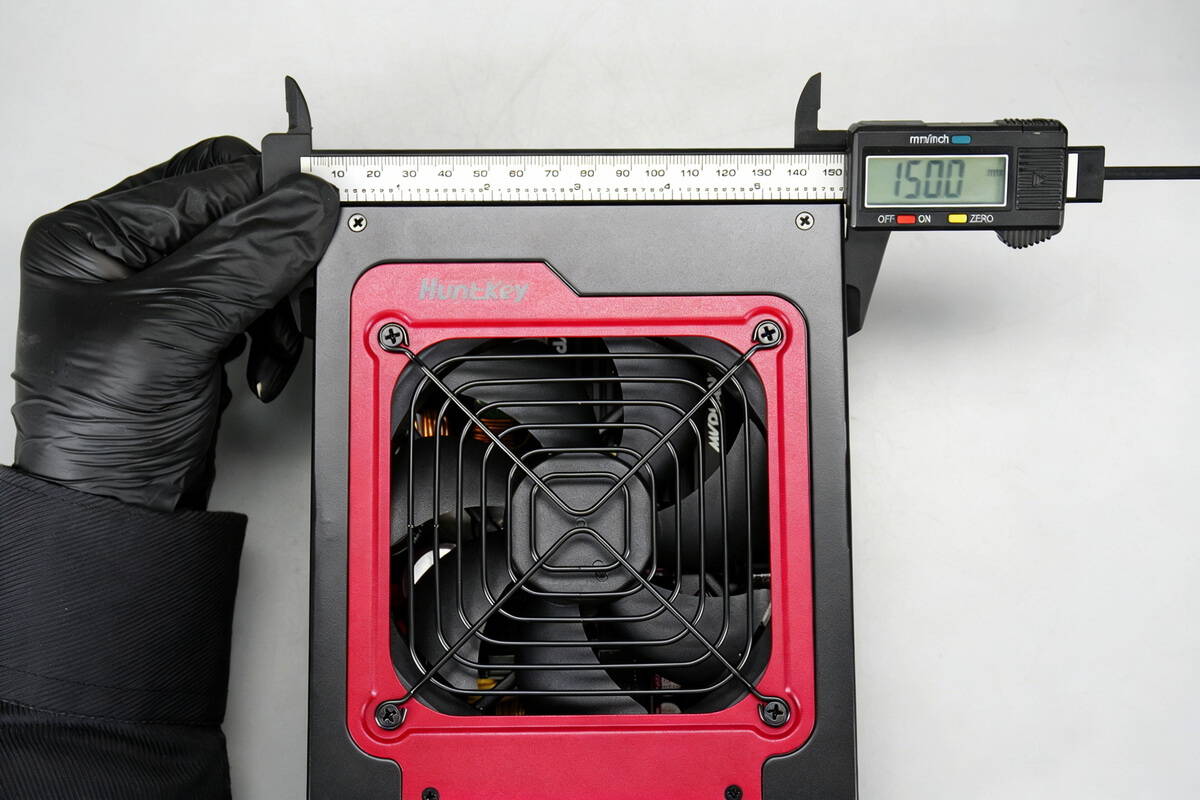
The width is about 150 mm (5.91 inches).
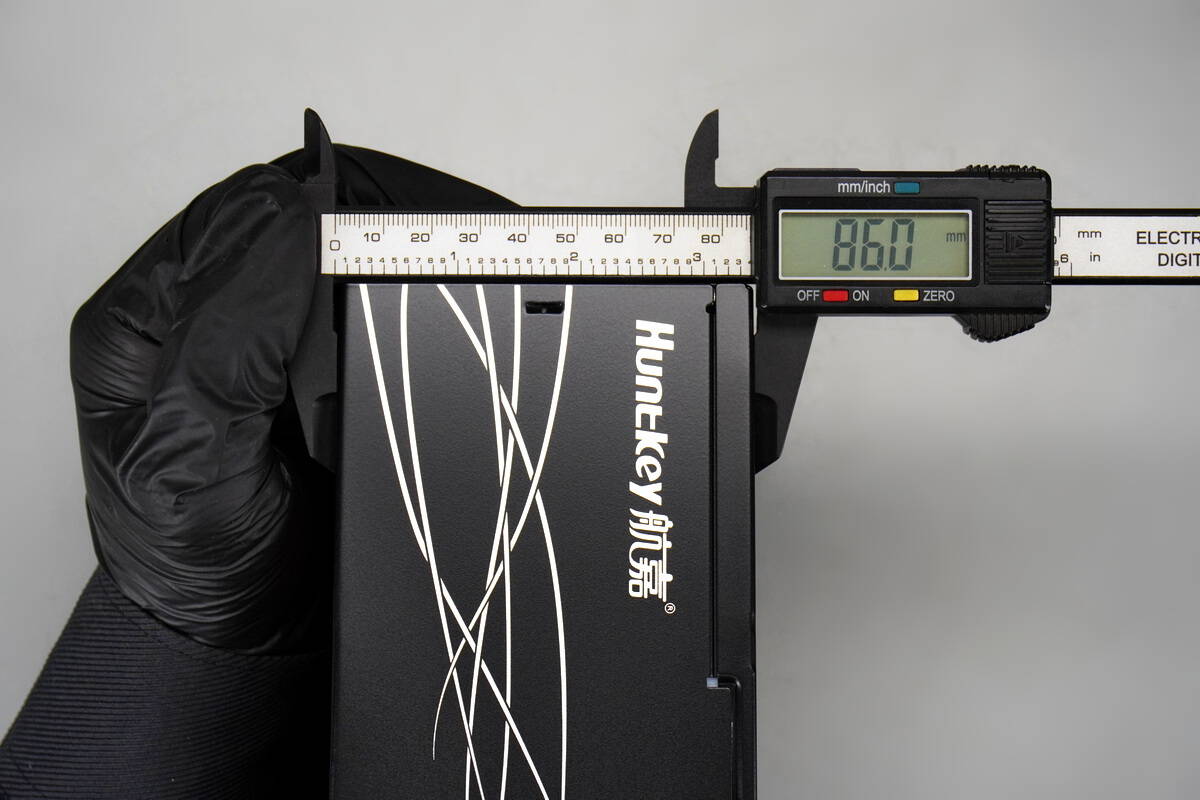
The thickness is about 86 mm (3.39 inches).
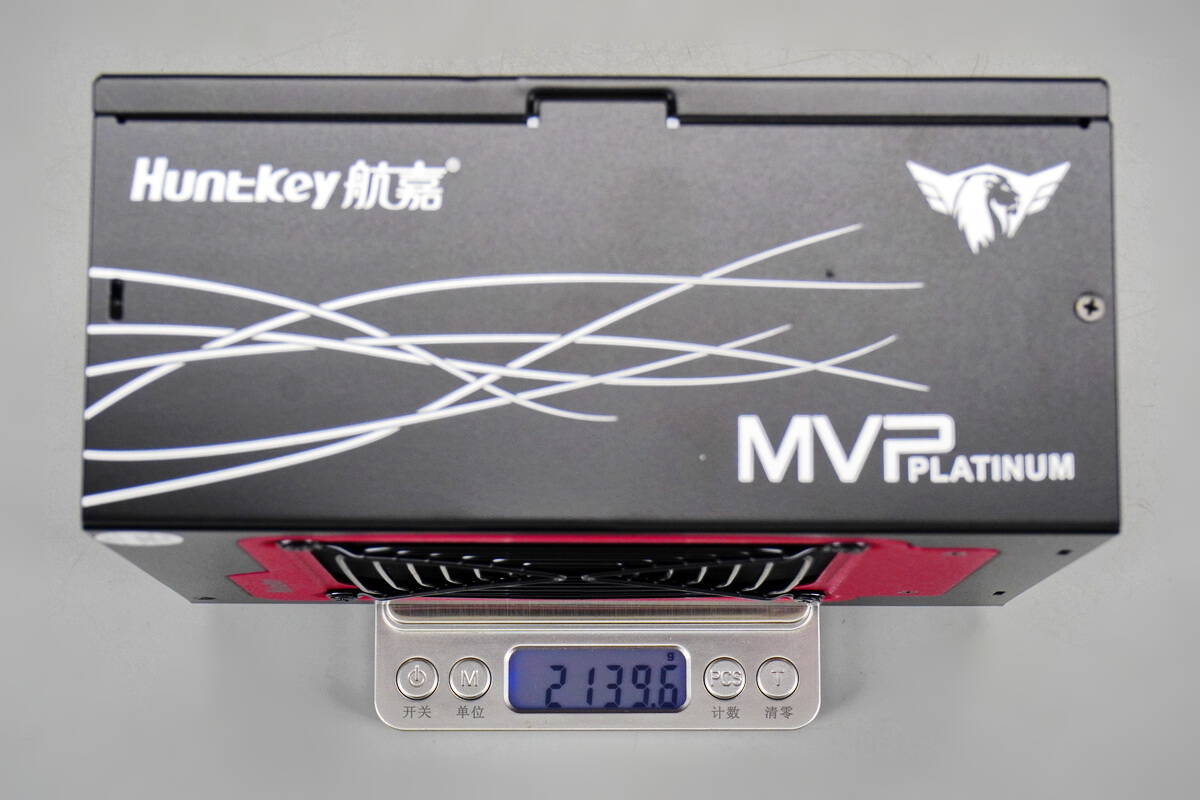
The weight is about 2140 g (75.49 oz).

The power plug is rated at 16A, 250V~.
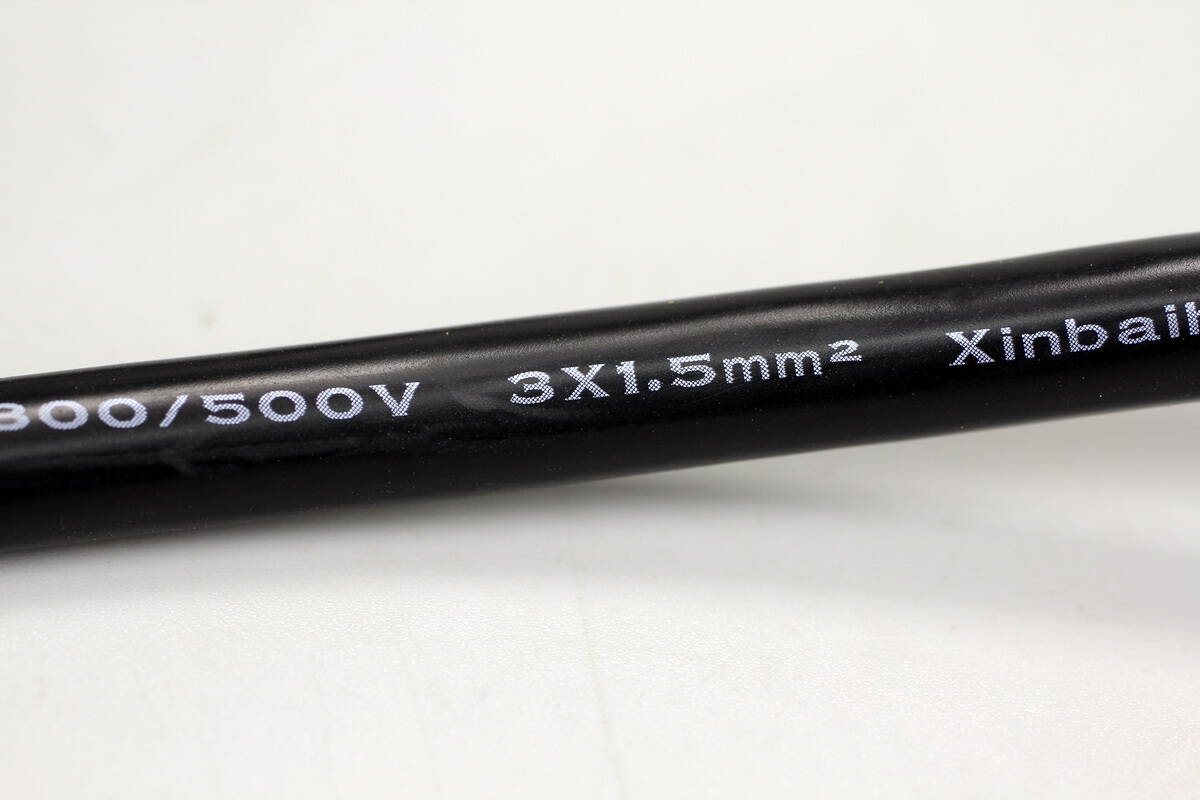
The power cable is specified as 3 × 1.5 mm².

The other end features a C19 connector.
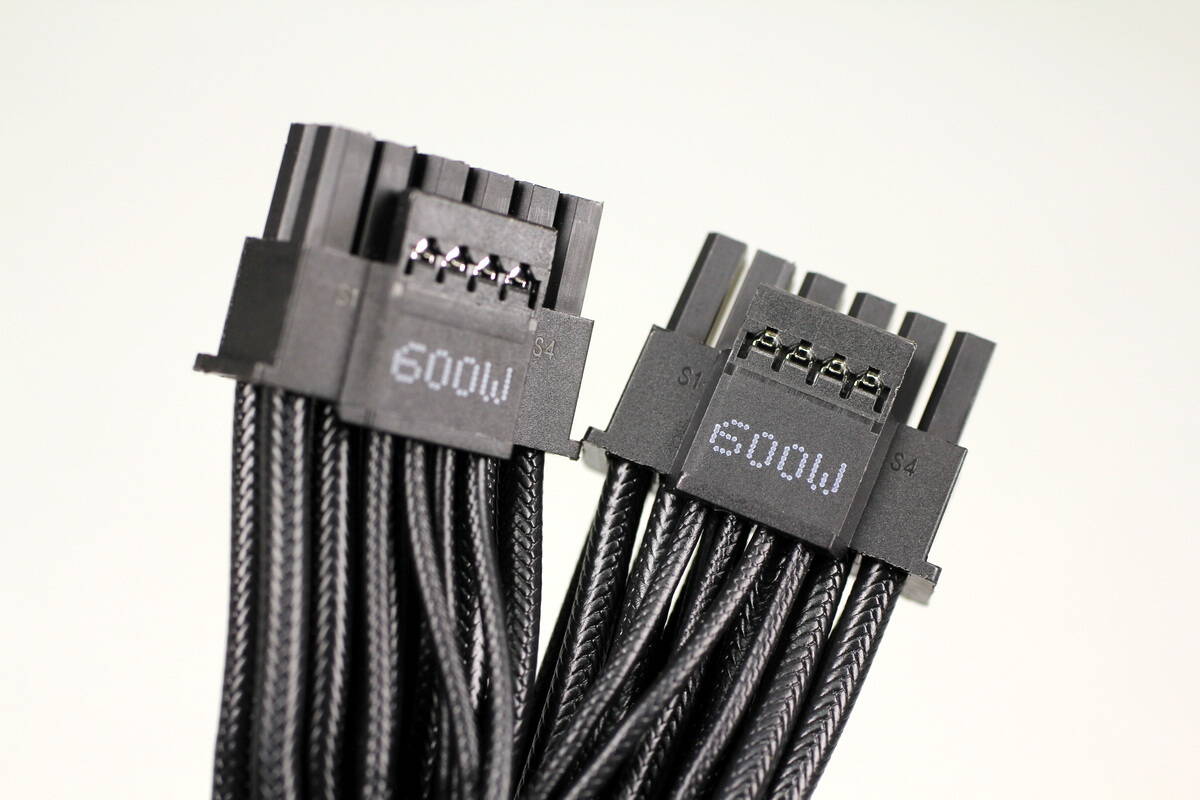
The PCIe 5.1 modular cable supports up to 600W of power.

The side of the plug is marked with “H++.”

Close-up of the modular cables.
Teardown
Next, let's take it apart to see its internal components and structure.

Unscrew the screws to open the casing. The upper cover houses a fan, connected via a plug-in connector.

The cooling fan is from Huntkey, model AB12025S12, rated at 12V 0.65A.

The PCBA module is secured inside the casing with screws, with Mylar sheets on both sides for insulation.
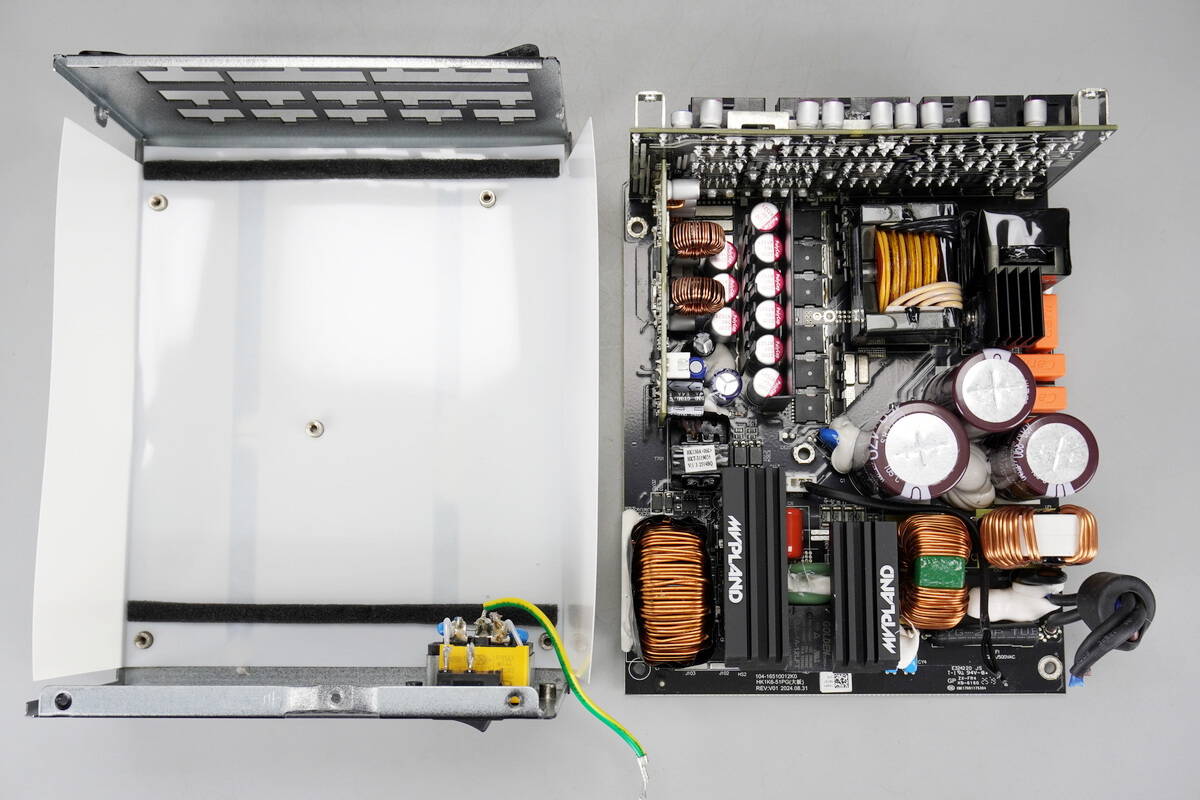
Remove the PCBA module from the casing.
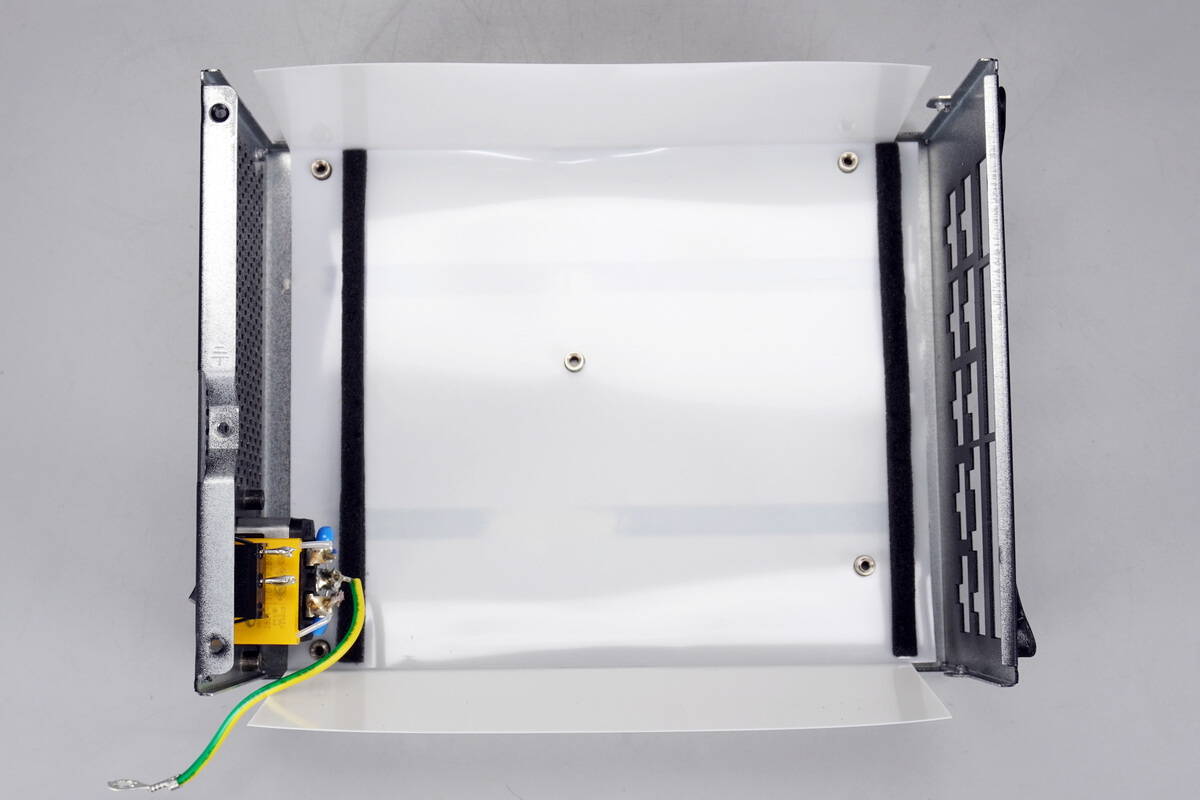
The Mylar sheets are affixed with foam padding for protection.

The input socket is secured with screws, with X2 and Y safety capacitors soldered to it.
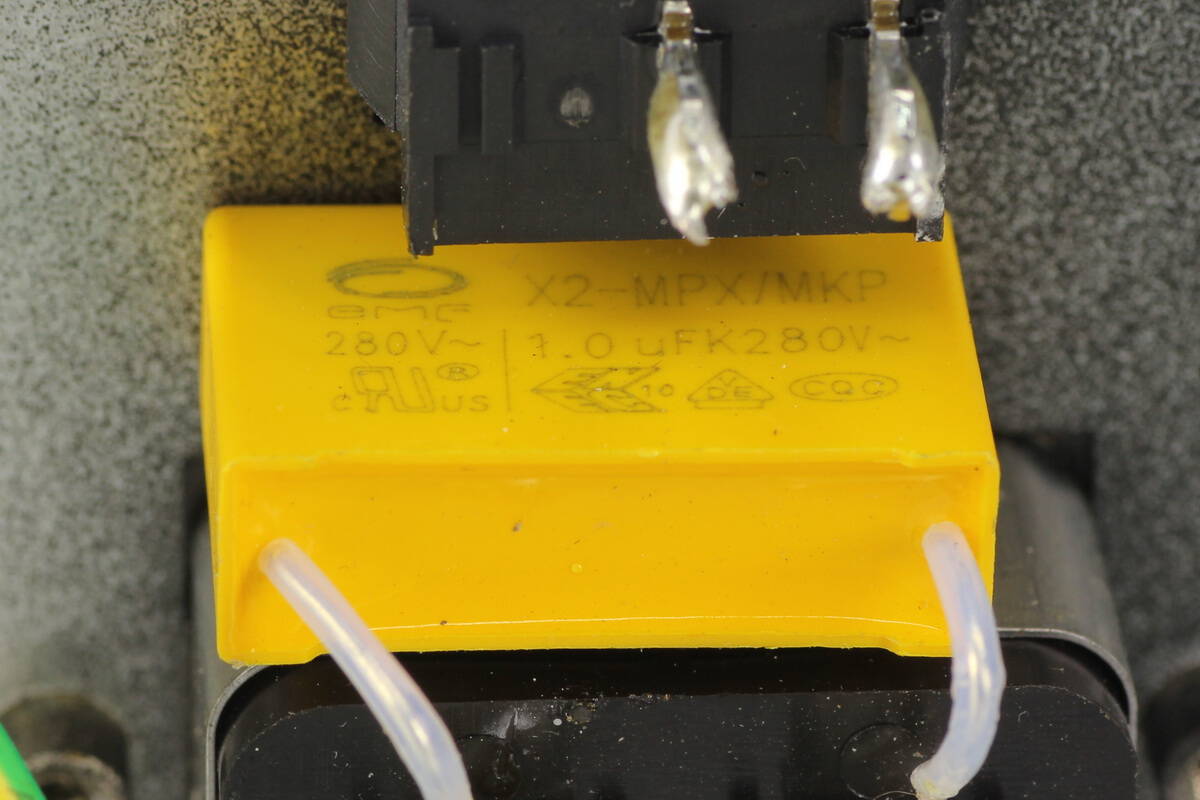
The X2 safety capacitor is from EMF, rated at 1 μF.
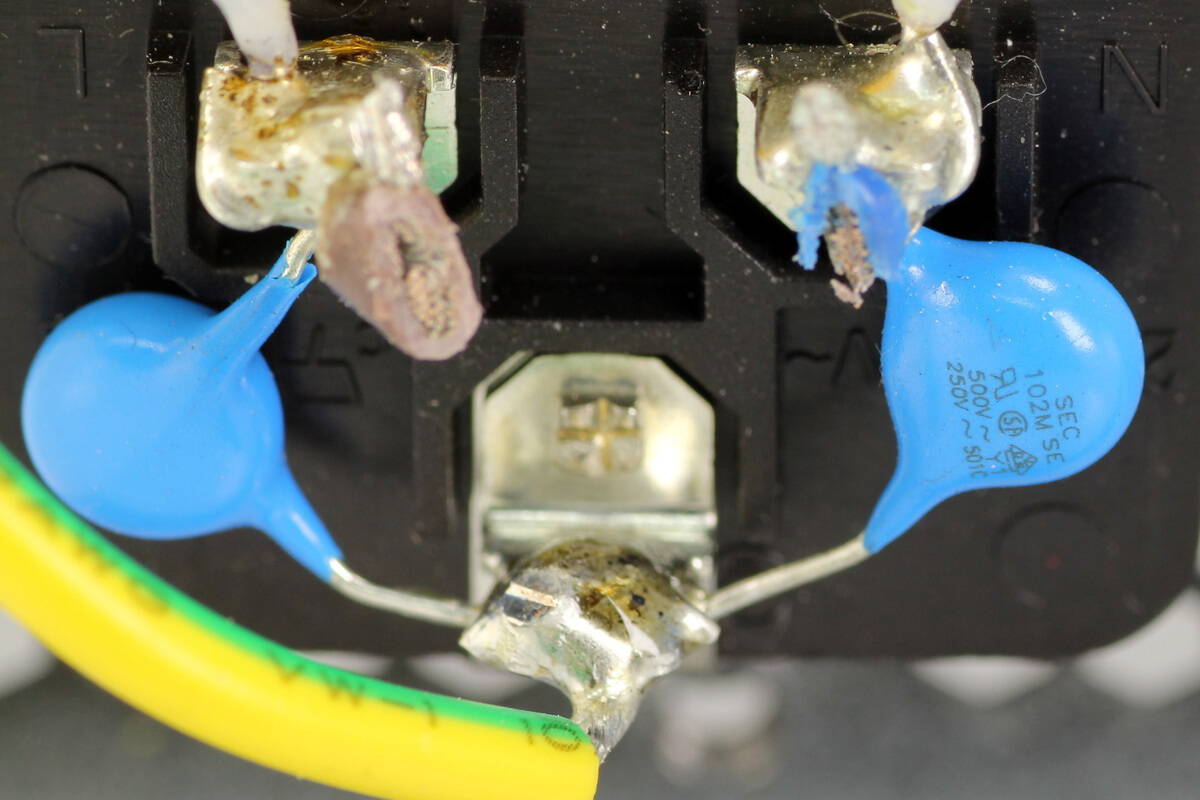
The two blue Y capacitors are from SEC, part number 102M.
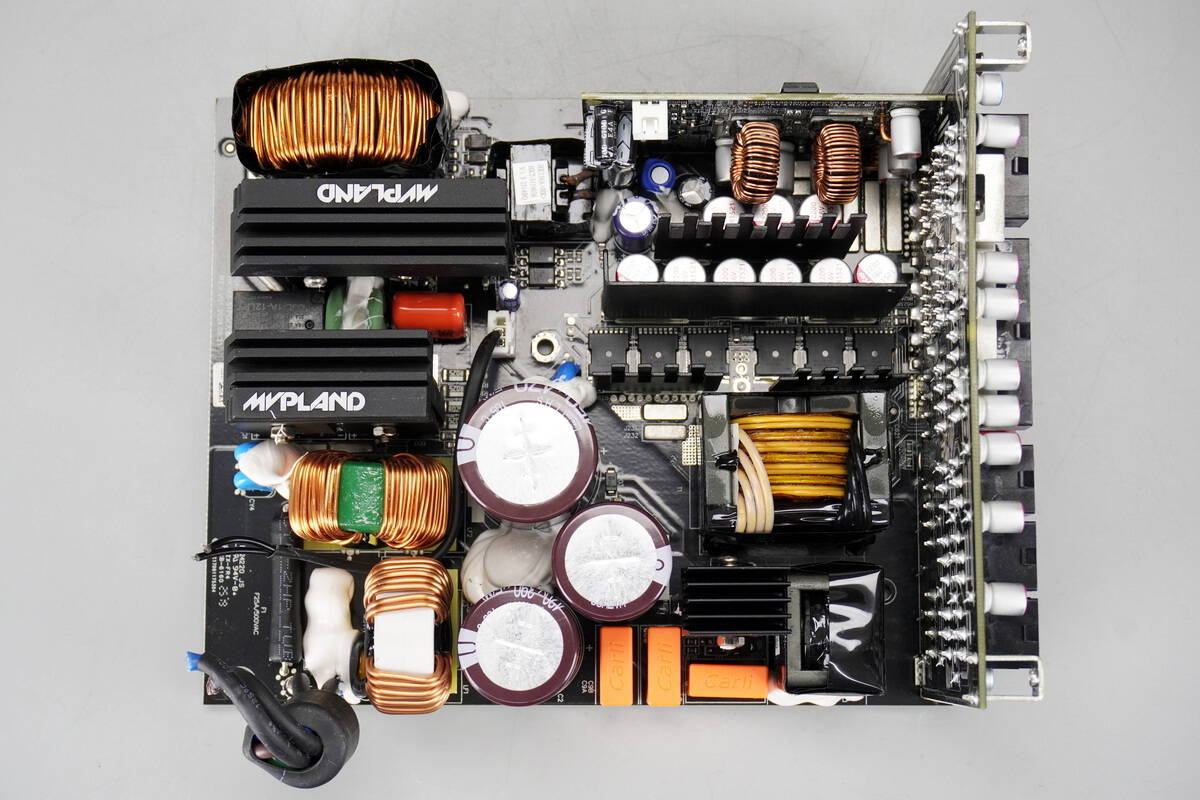
The front side of the PCBA module features a fuse, varistor, safety X2 capacitor, common-mode chokes, bridge rectifiers, PFC boost inductor, PFC MOSFETs, PFC rectifiers, standby power transformer, high-voltage filter capacitors, LLC MOSFETs, resonant capacitors, resonant inductor, and other components.
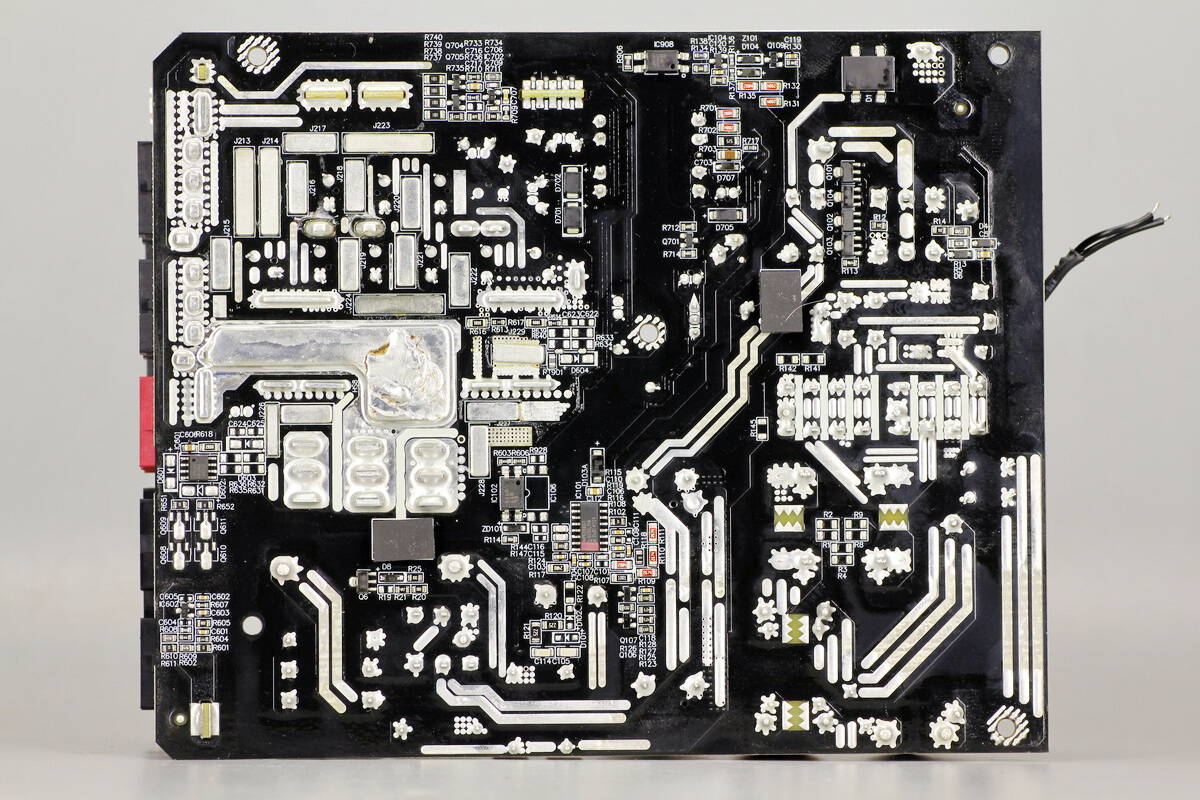
The back side contains a PFC + LLC controller, synchronous rectifier controller, bridge rectifiers, and other components.
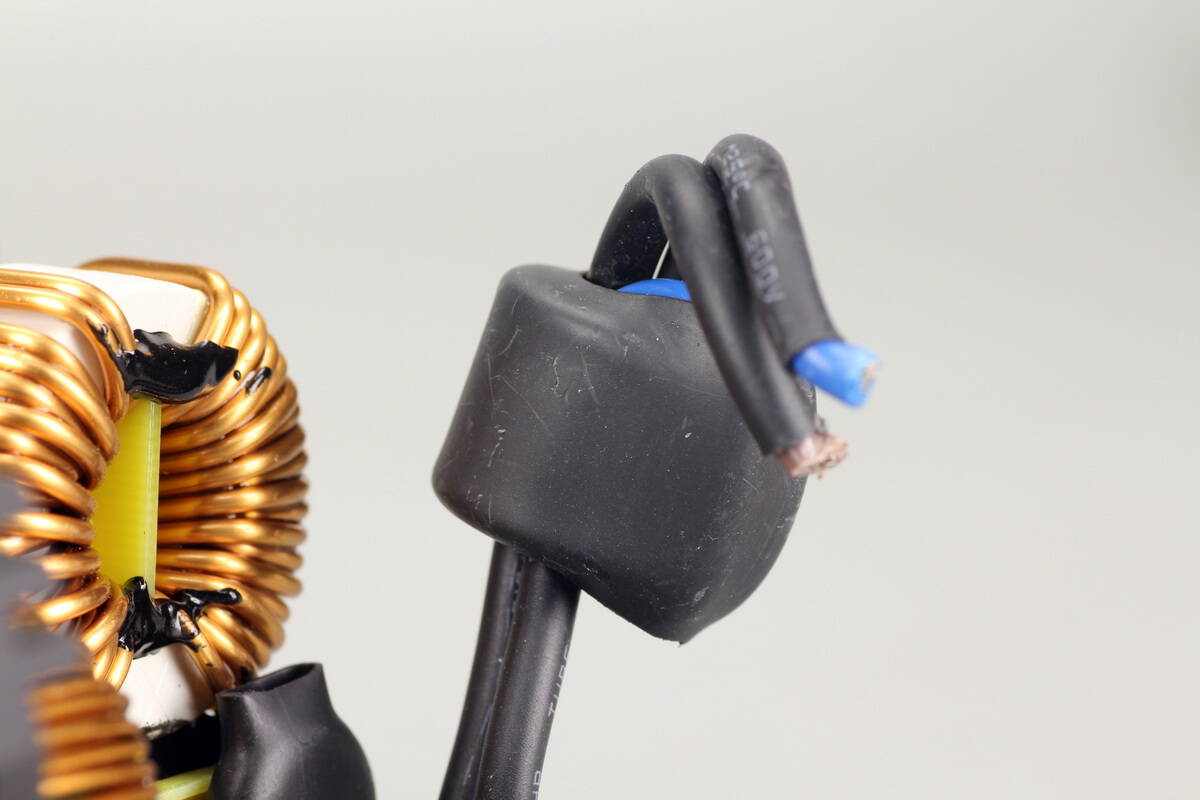
The input cable passes through a ferrite ring to suppress high-frequency interference.
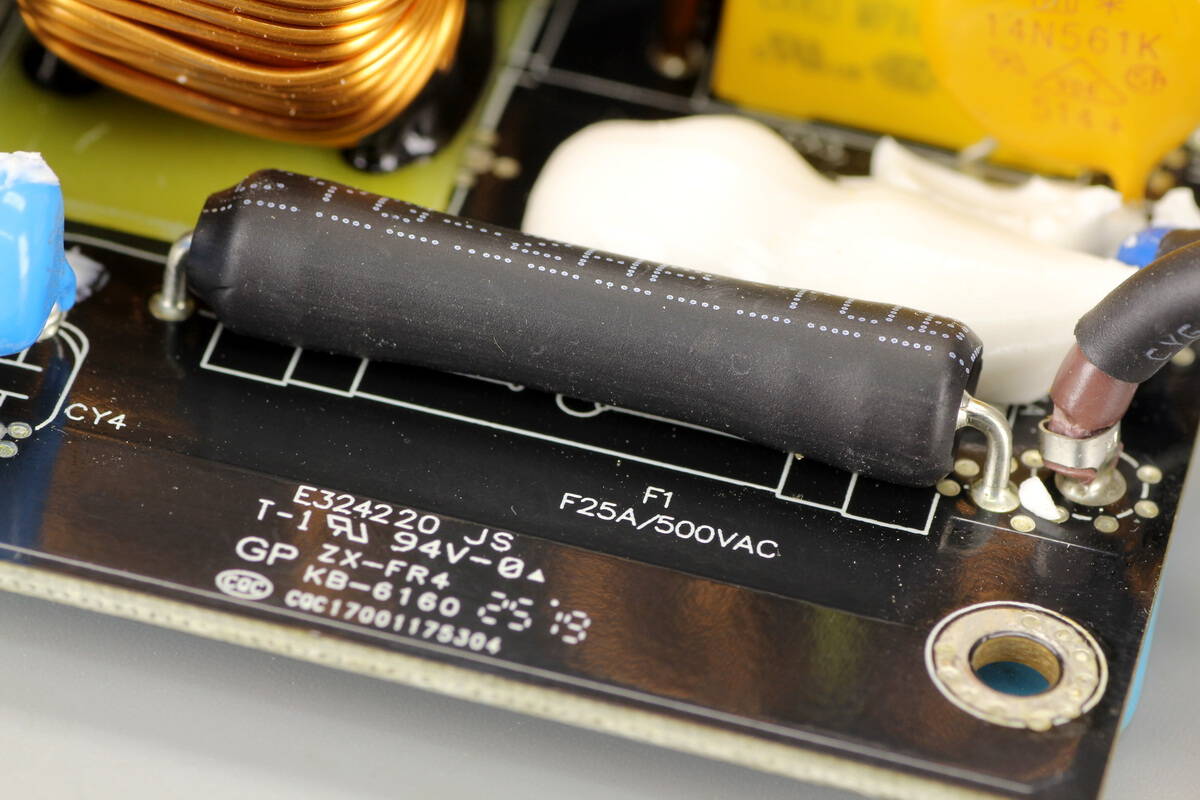
The input fuse is rated at 25A, 500V, and is insulated with a heat-shrink tube.
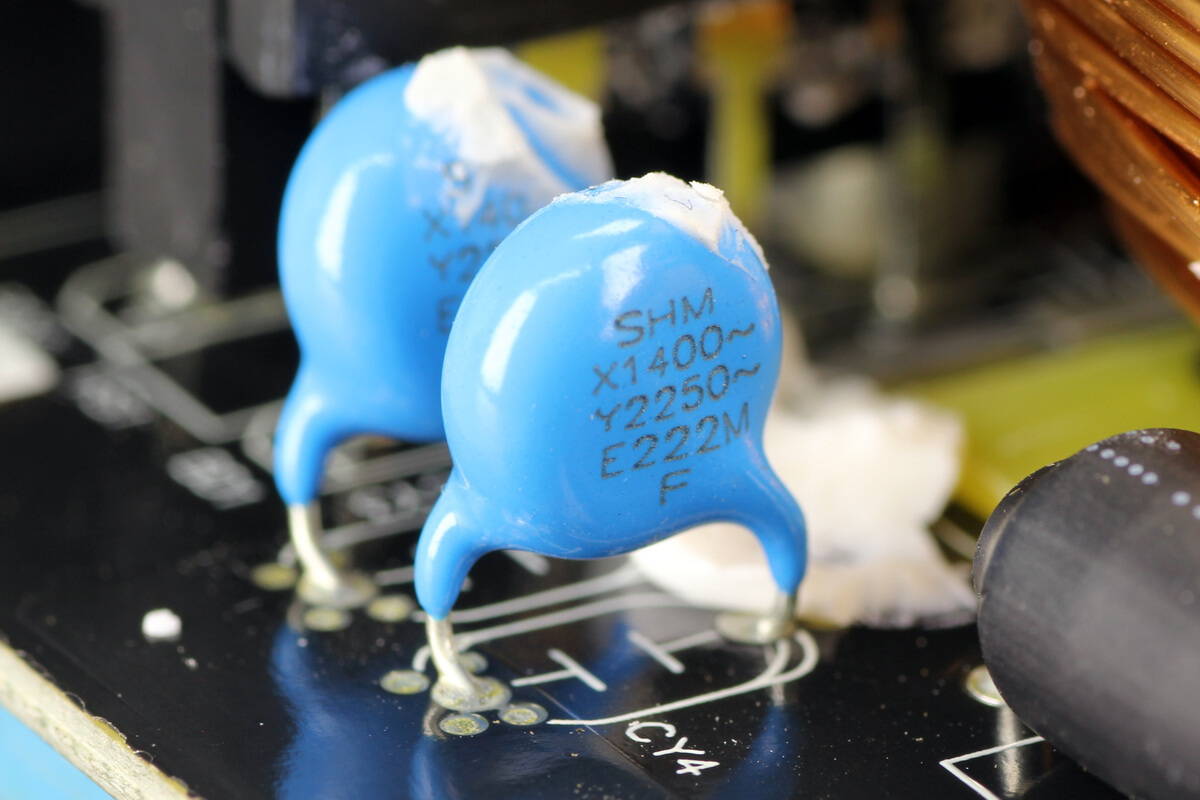
The blue Y capacitors are from SHM, part number E222M.
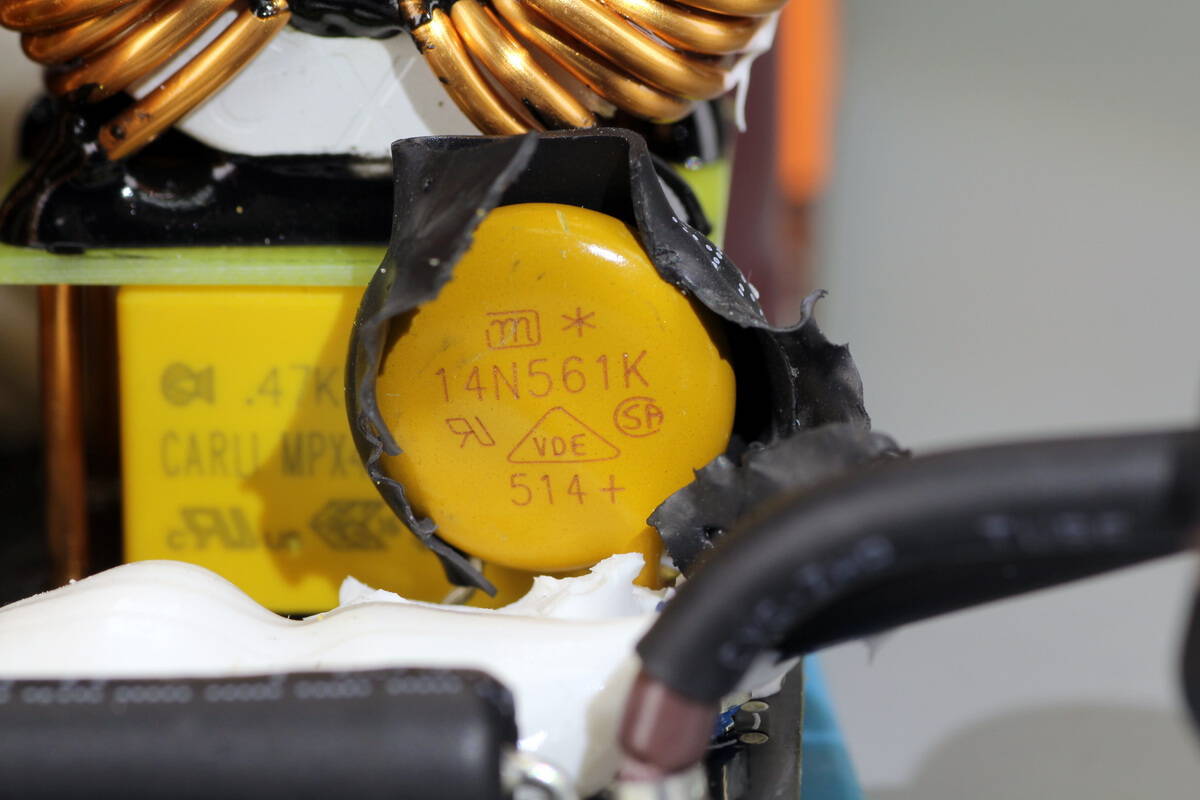
The varistor is from JOYIN, model 14N561K, and is insulated with a heat-shrink tube.
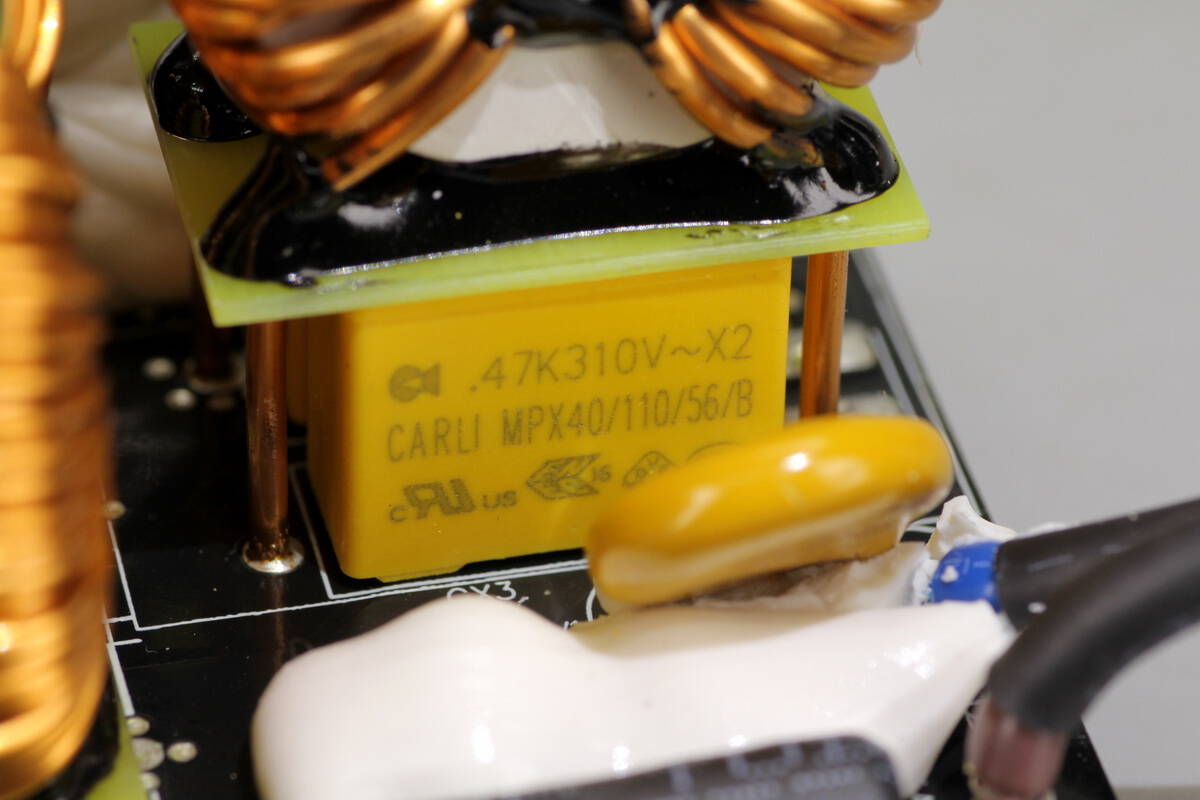
The safety X2 capacitor is from Carli, rated at 0.47 μF, and soldered beneath the common-mode choke.

The common-mode choke is wound with enamel-coated wire and features a Bakelite insulating board at the base.

The other common-mode choke is also wound with enamel-coated wire.

Four bridge rectifiers are mounted on the heatsink.
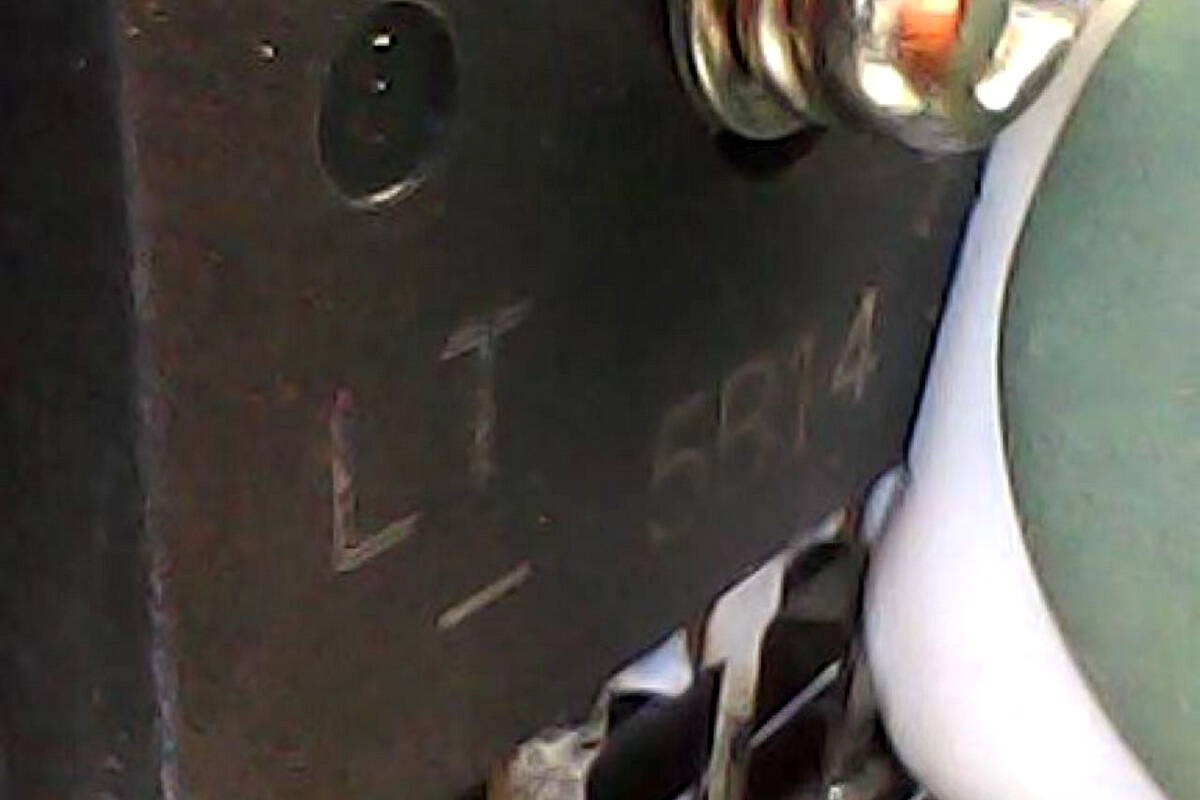
The bridge rectifiers are from LITEON.

Model: GBU2510, rated at 1000 V, 25 A, in a GBU package.
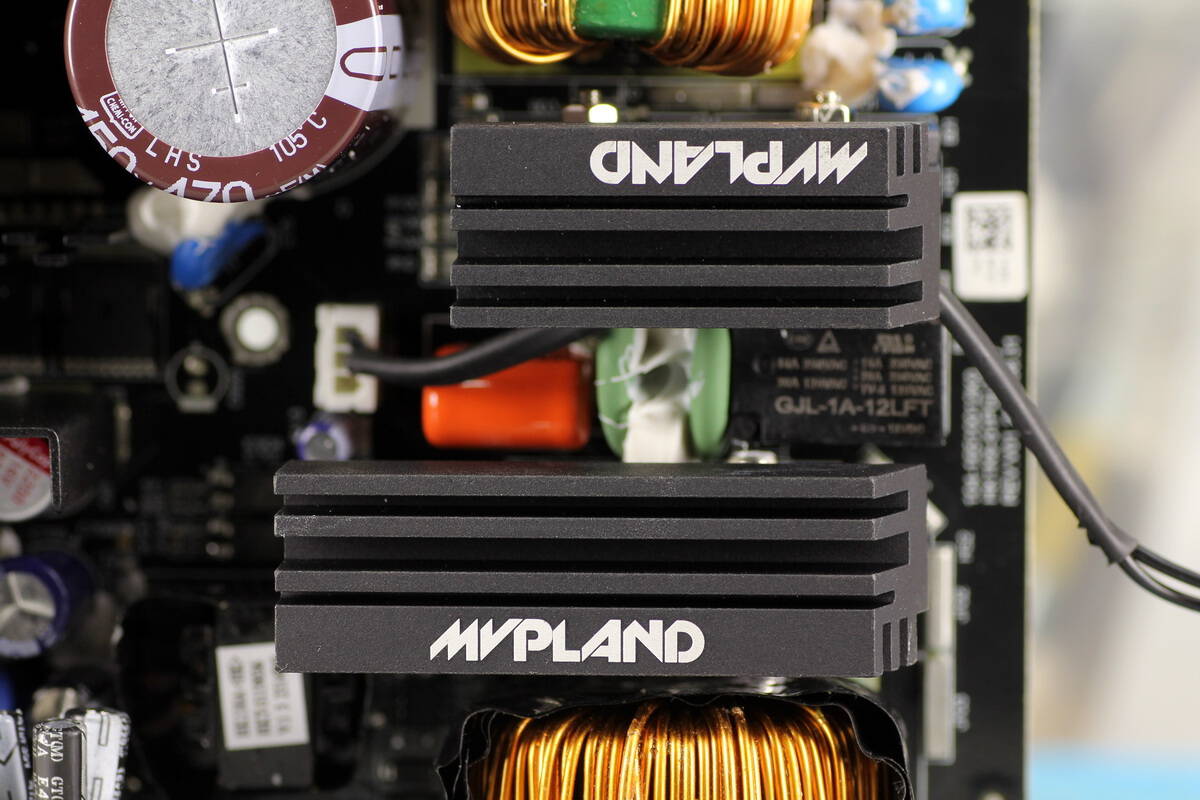
Between the two heatsinks are a film capacitor, an NTC thermistor, and a relay.
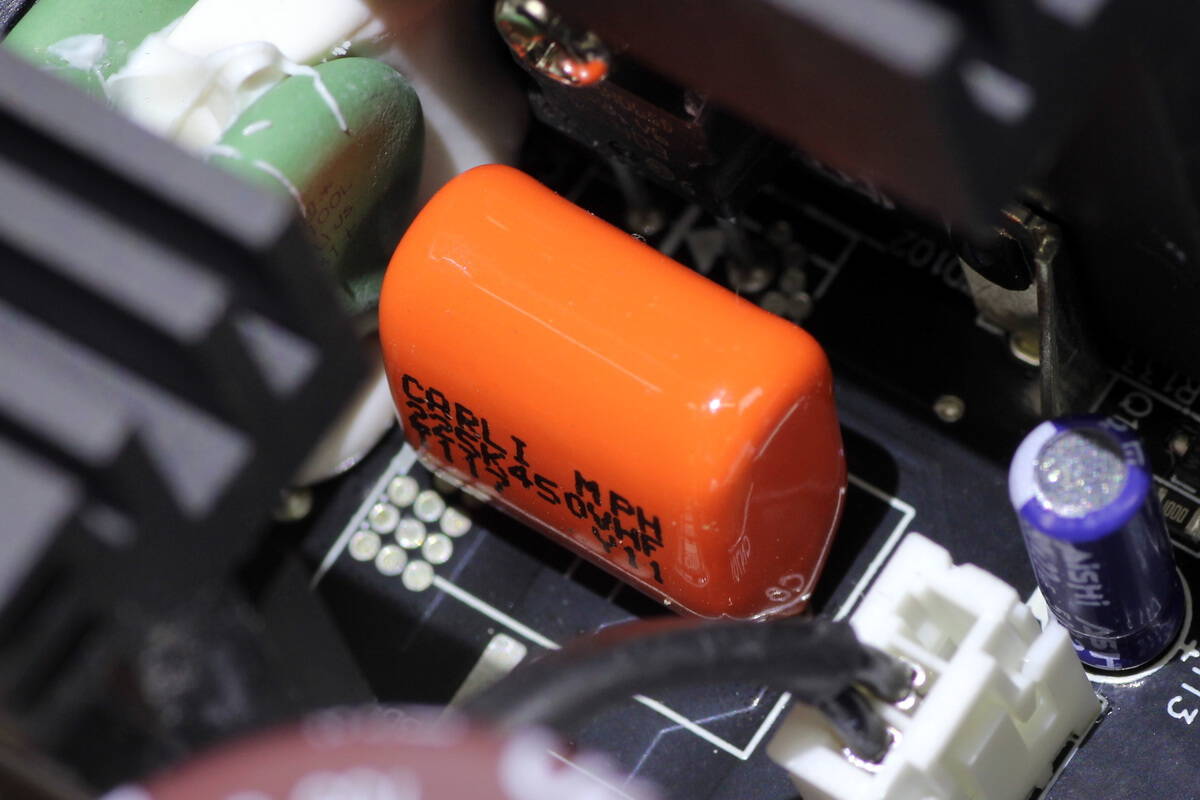
The film capacitor is from Carli, rated at 2.2 μF, 450 V.
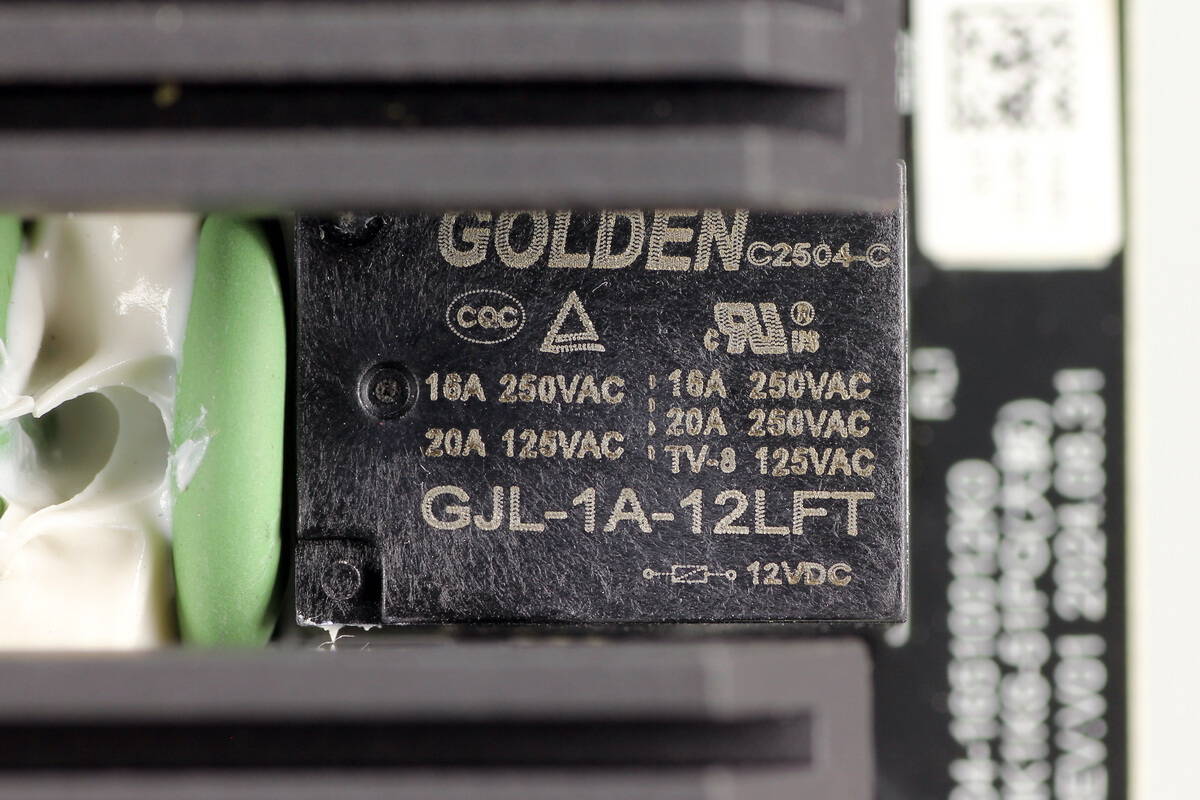
Relay from GOLDEN, model GJL-1A-12LFT, is an ultra-compact high-power relay with a contact rating of 20A at 250VAC and a coil voltage of 12V.

The NTC thermistor is from JOYIN, model 20S100L, and is used to suppress inrush current during power-on.

The master control chip is from NXP, marked HKP6288AT. It integrates both PFC and LLC controllers and drivers, and comes in an SO16 package.
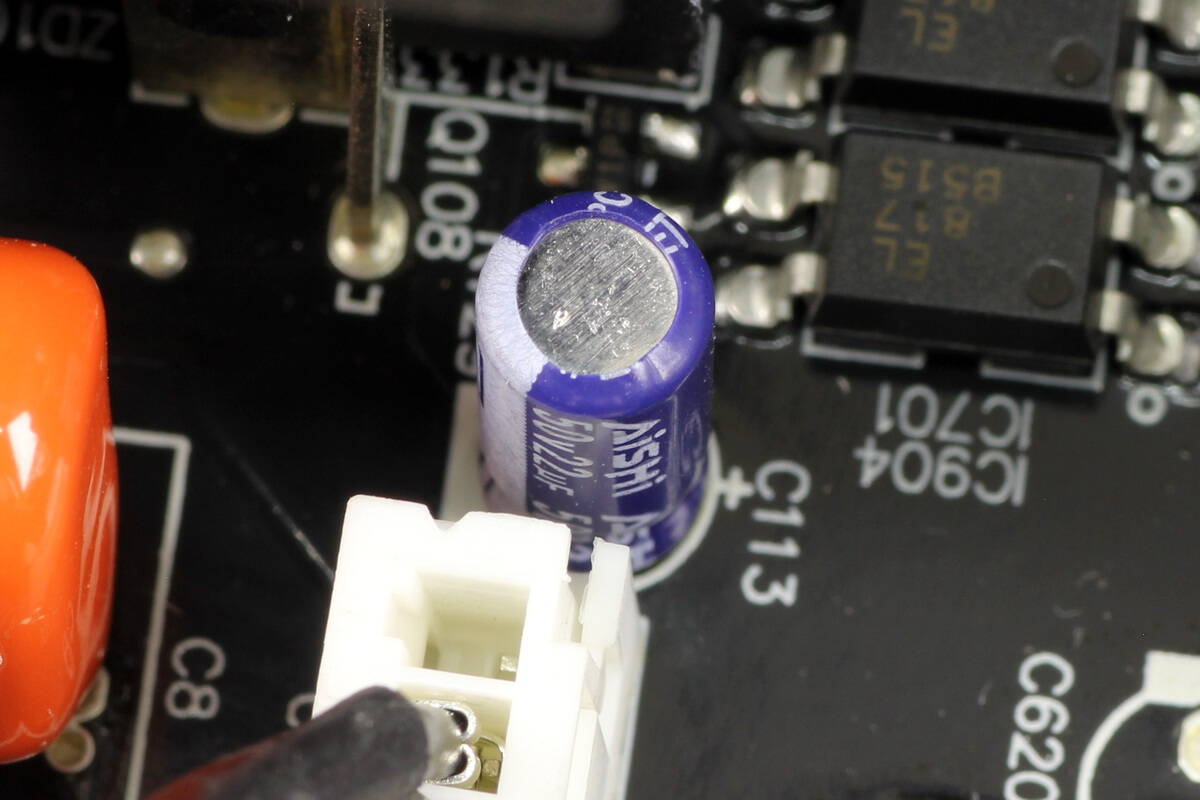
The filter capacitor supplying power to the master control chip is from AiSHi, with a rating of 50 V 22 μF.
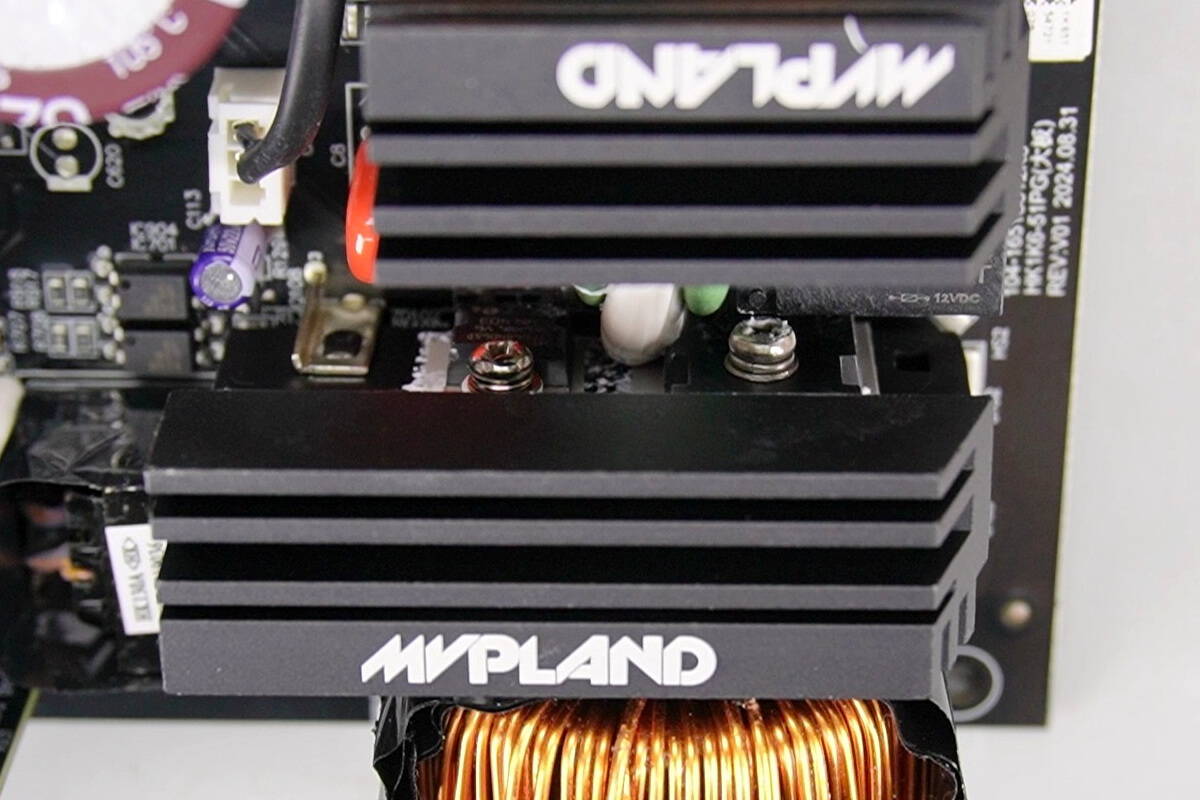
The PFC MOSFET and rectifier are mounted on the heatsink.

On the other side, there are also PFC MOSFETs and rectifier diodes.
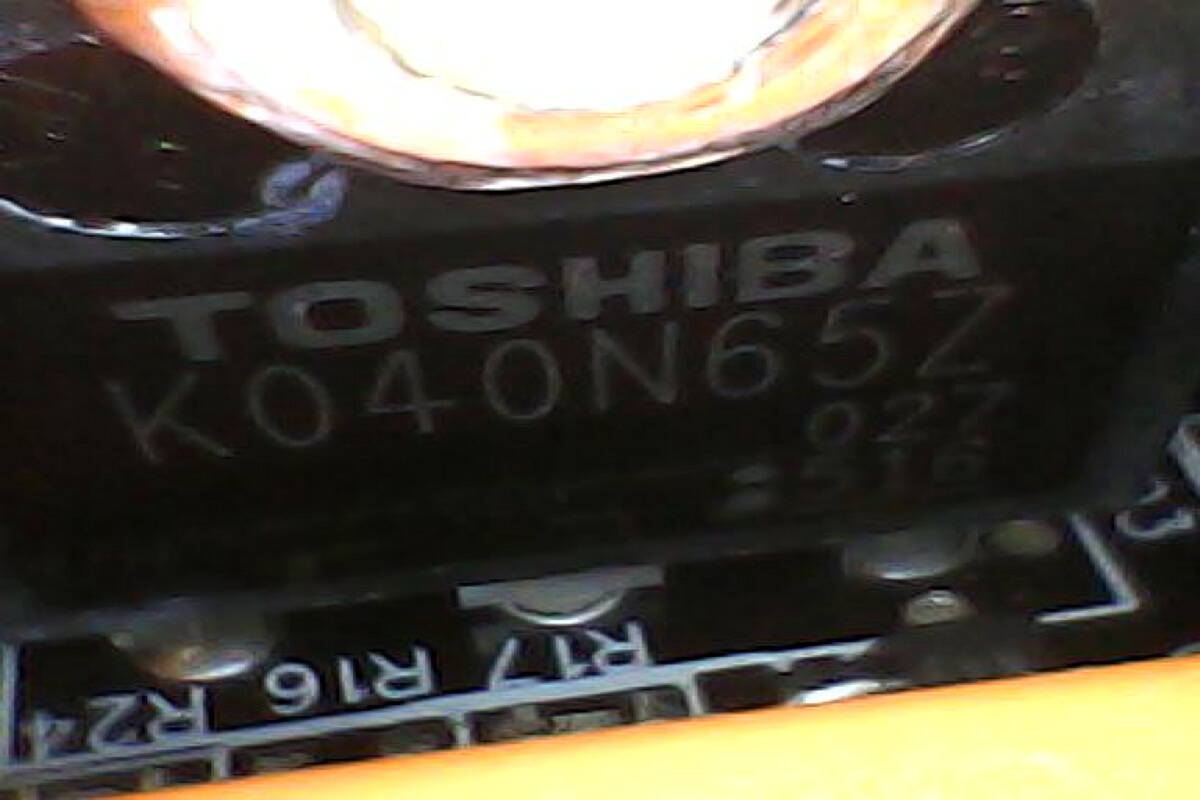
The PFC MOSFET is from Toshiba, model TK040N65Z. It is an N‑channel MOSFET with a voltage rating of 650 V, an on-resistance of 33 mΩ, and comes in a TO‑247 package.

The other one has the same model.
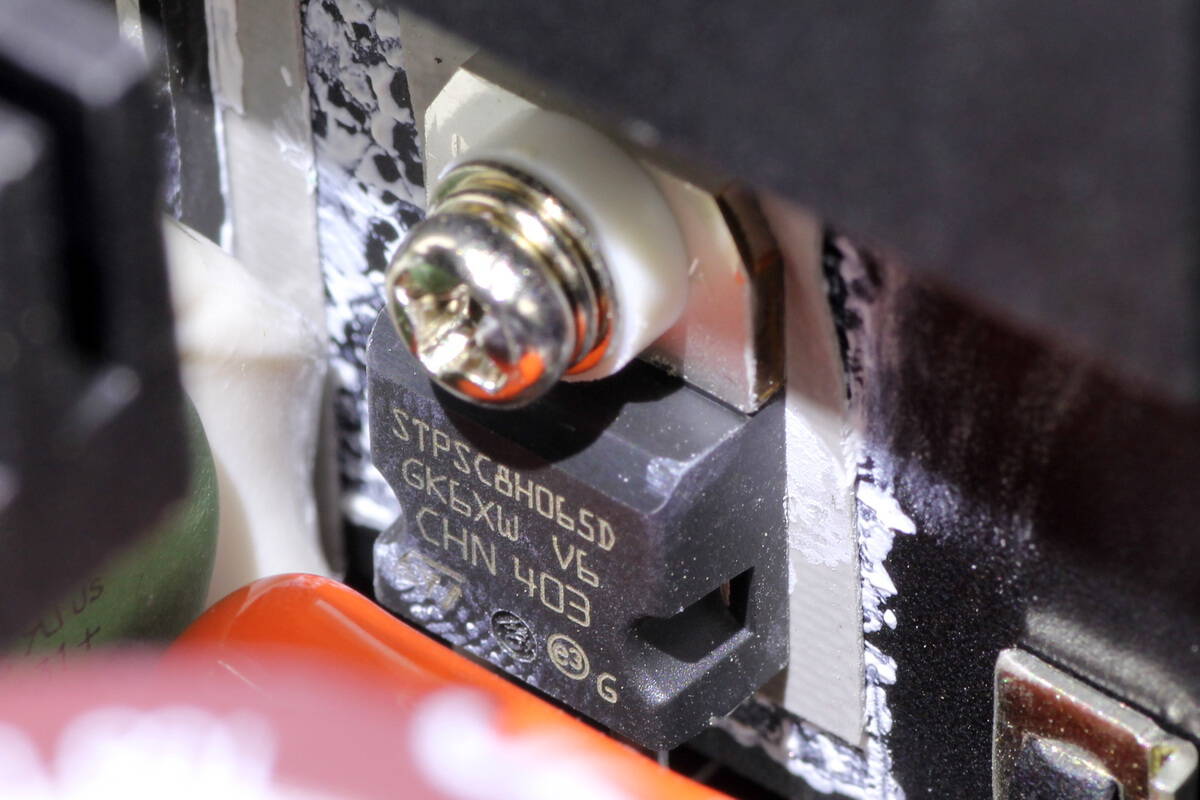
The PFC rectifier is from STMicro, model STPSC8H065D. It is a silicon carbide diode rated at 650 V and 8 A, featuring high surge current capability and housed in a TO-220AC package.
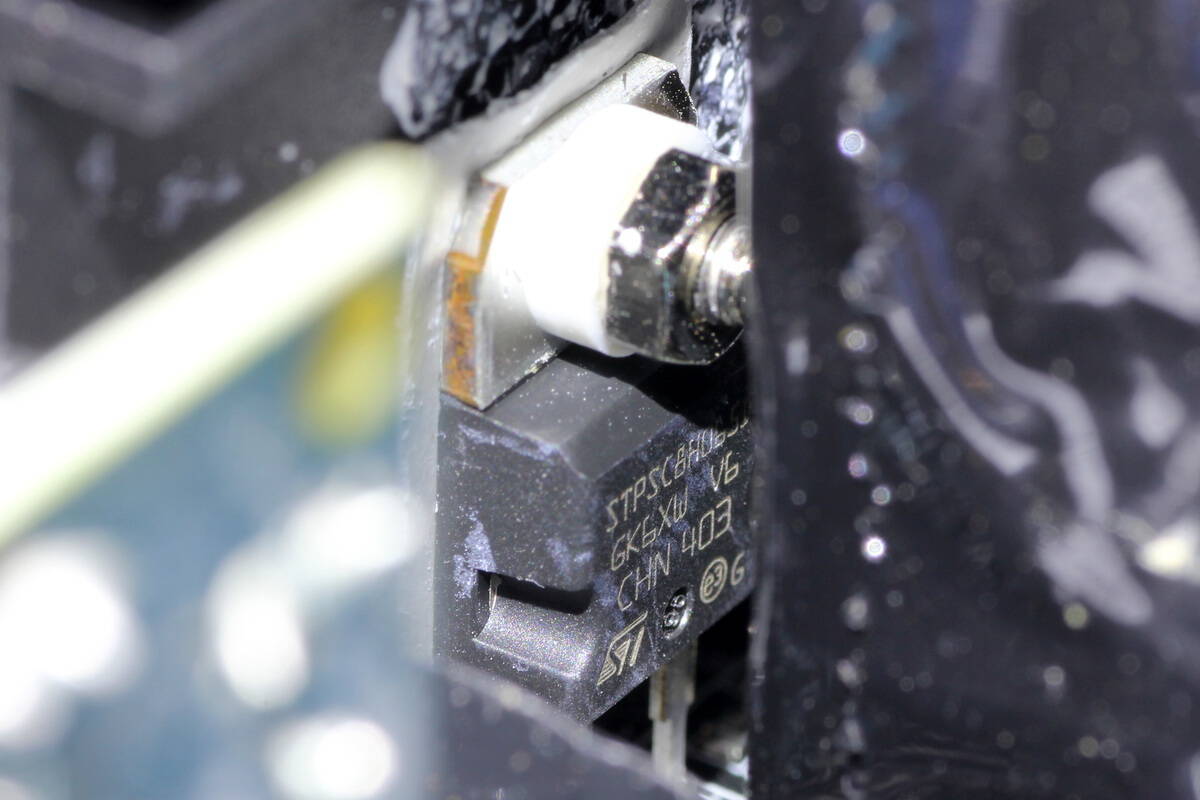
Another PFC rectifier is from STMicro, with the same model.

Four 25 mΩ sense resistors are connected in parallel for monitoring the current of the PFC MOSFETs.

The PFC boost inductor is wound with enameled wire, insulated with tape, and reinforced with adhesive.
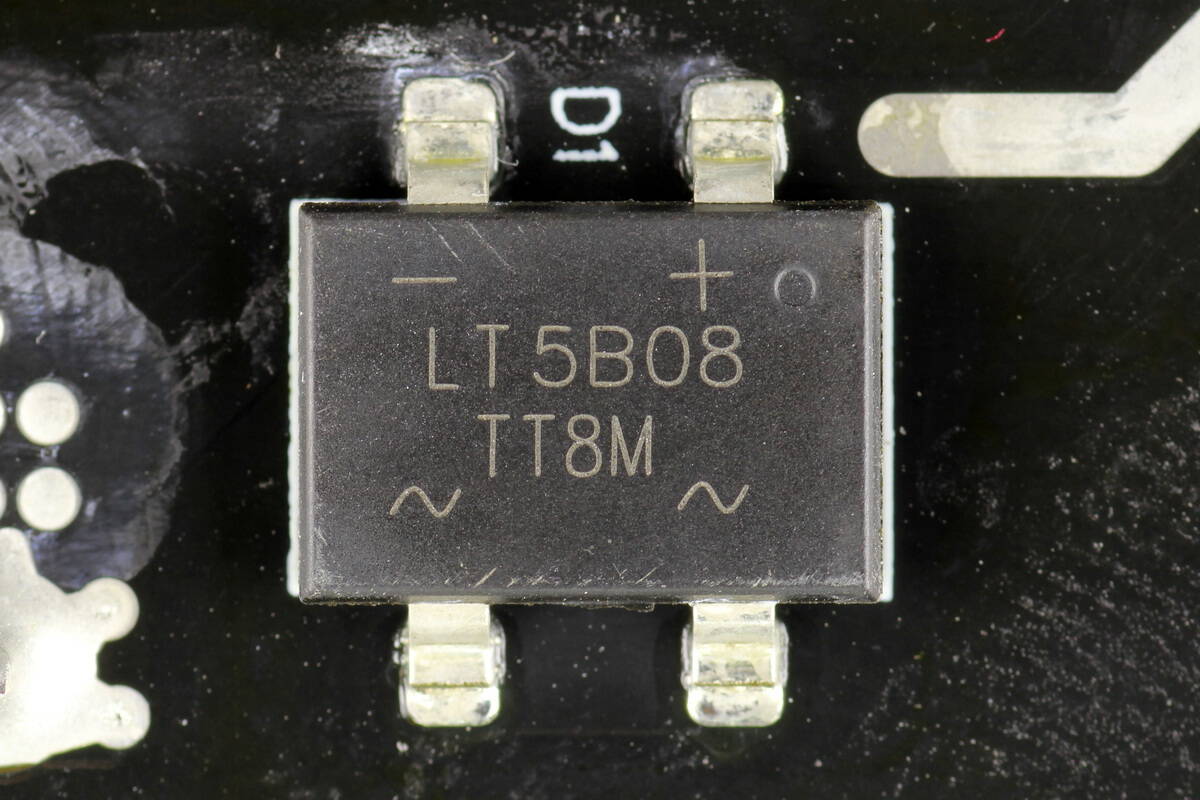
The bridge rectifier is from LITEON, model TT8M, rated at 1000 V 8 A, and comes in a TT package.
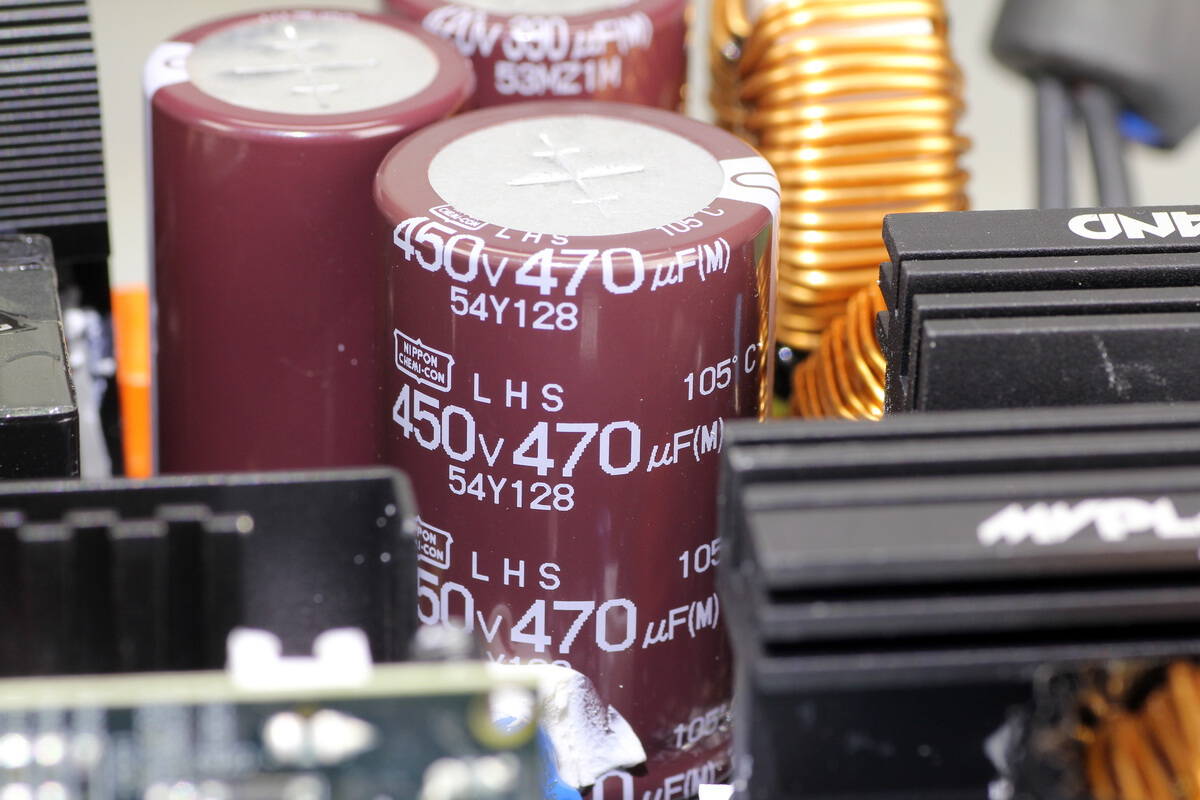
The high-voltage filter capacitor is from NCC, part of the LHS series of long-life electrolytic capacitors, rated at 450 V, 470 μF.
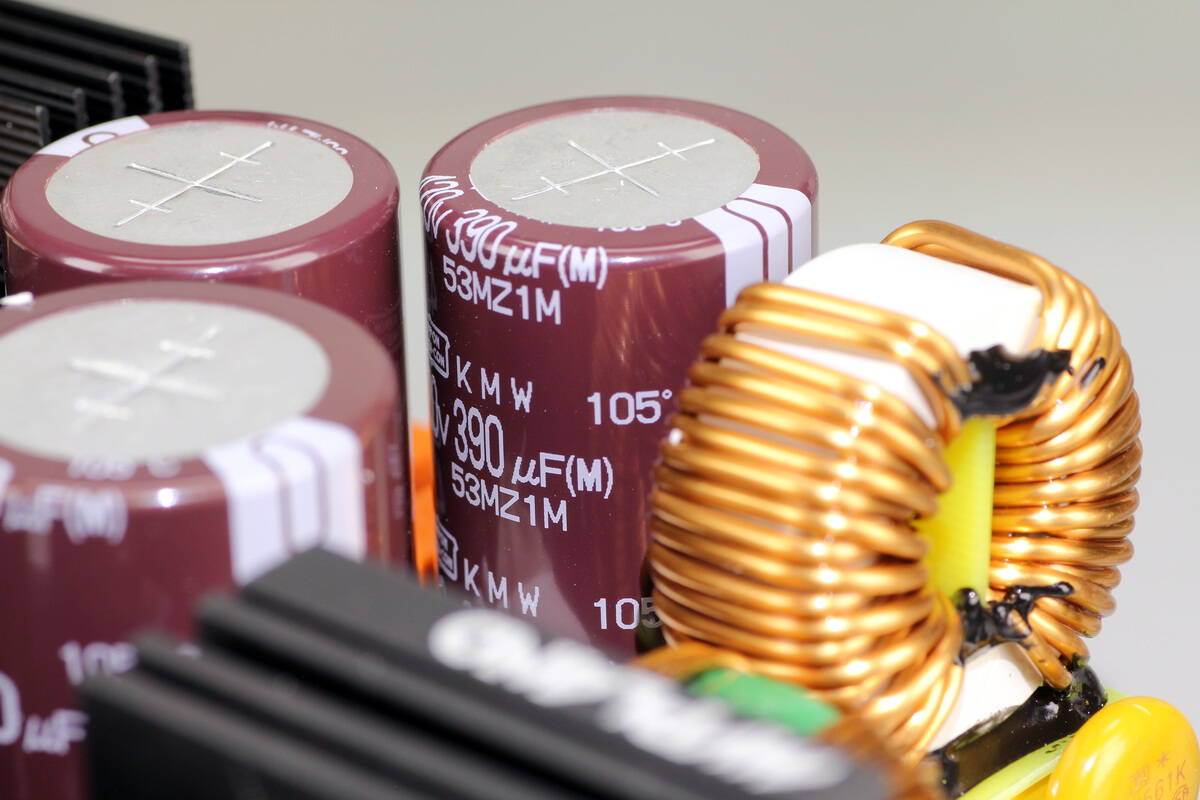
The other two filter capacitors are also from NCC, part of the KMW series of electrolytic capacitors, rated at 420 V, 390 μF.
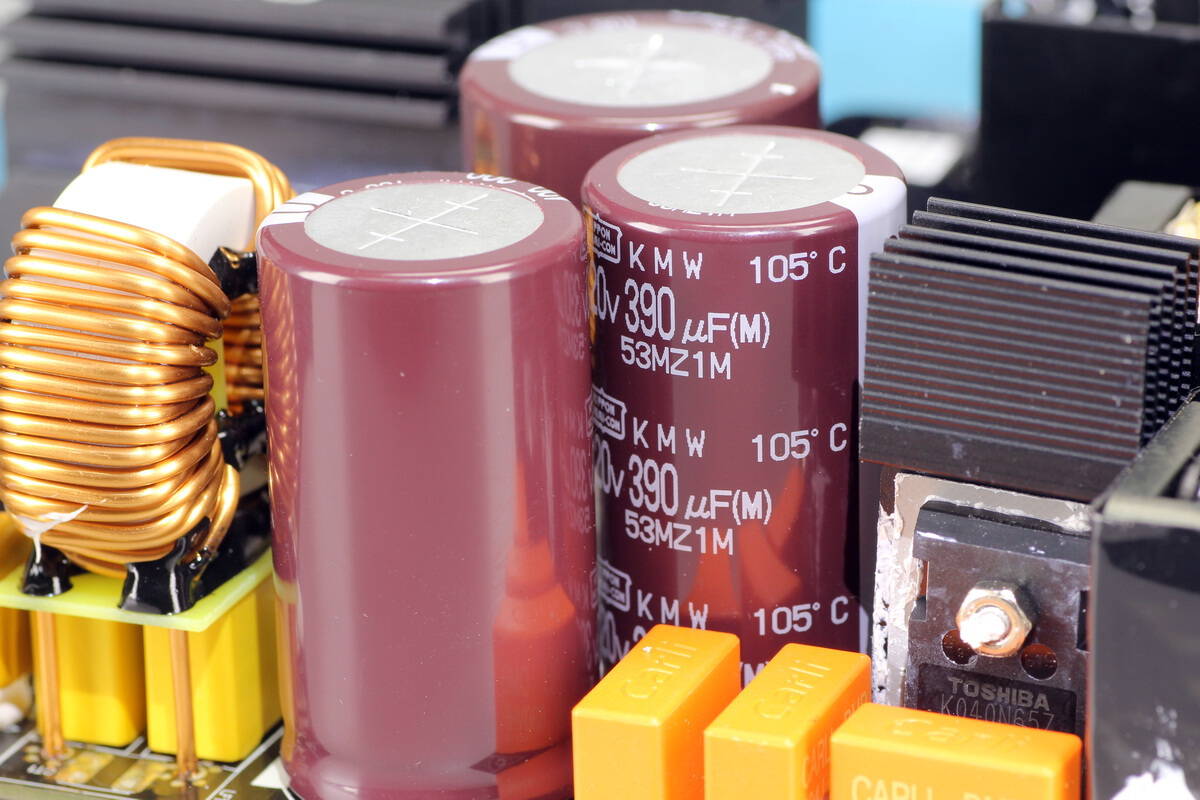
Another filter capacitor has the same specifications, bringing the total filter capacitance to 1250 μF.
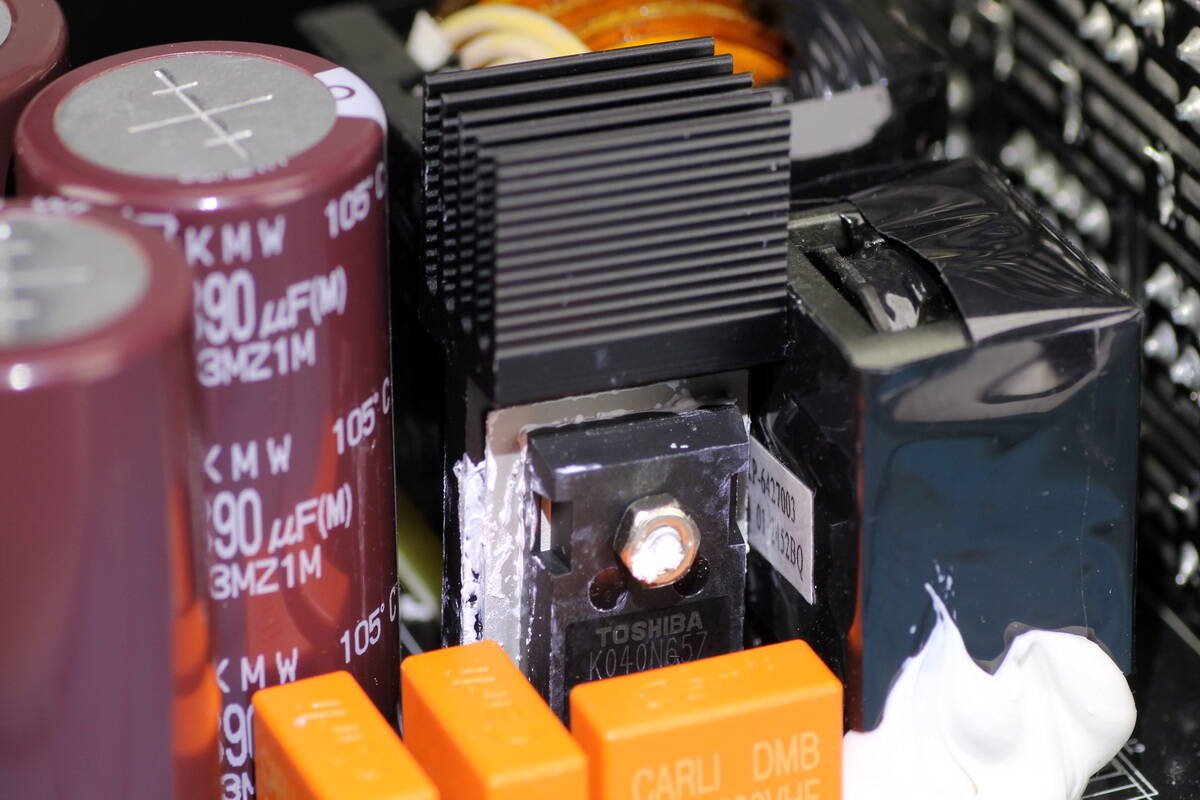
The heat sink is equipped with an LLC MOSFET.
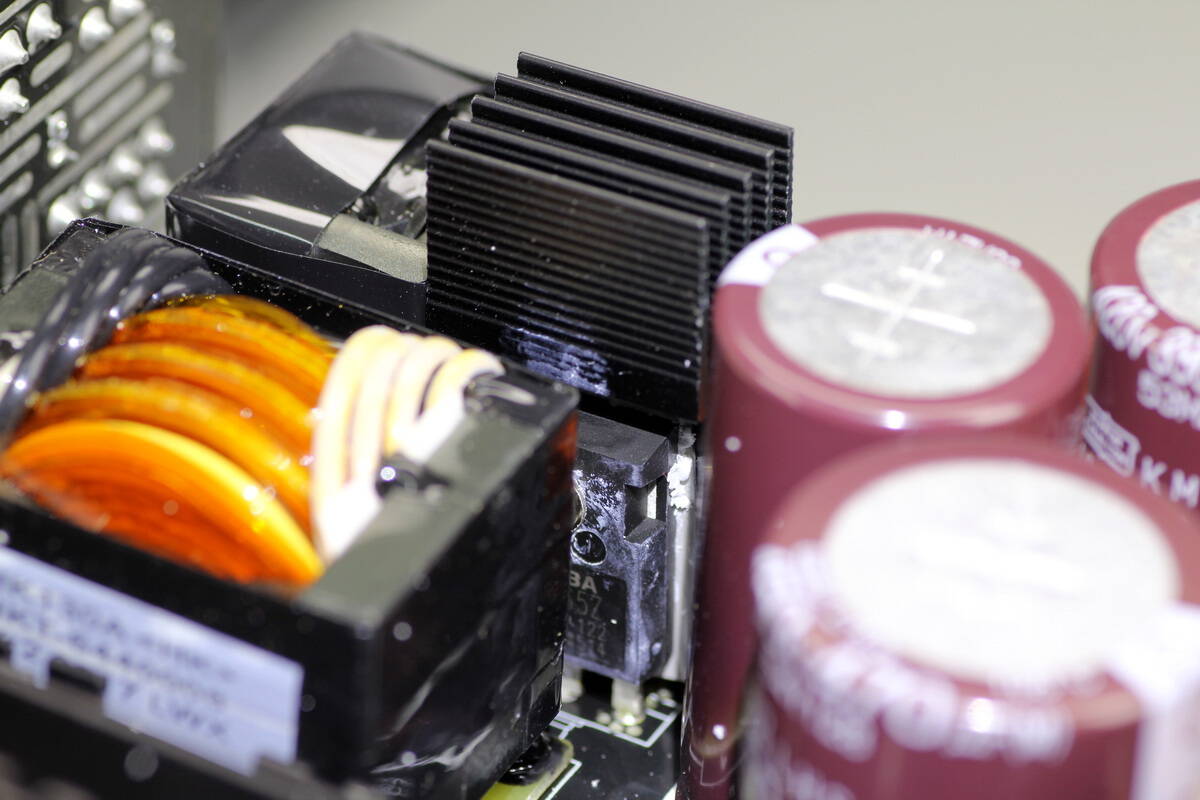
The other side also features an LLC MOSFET.
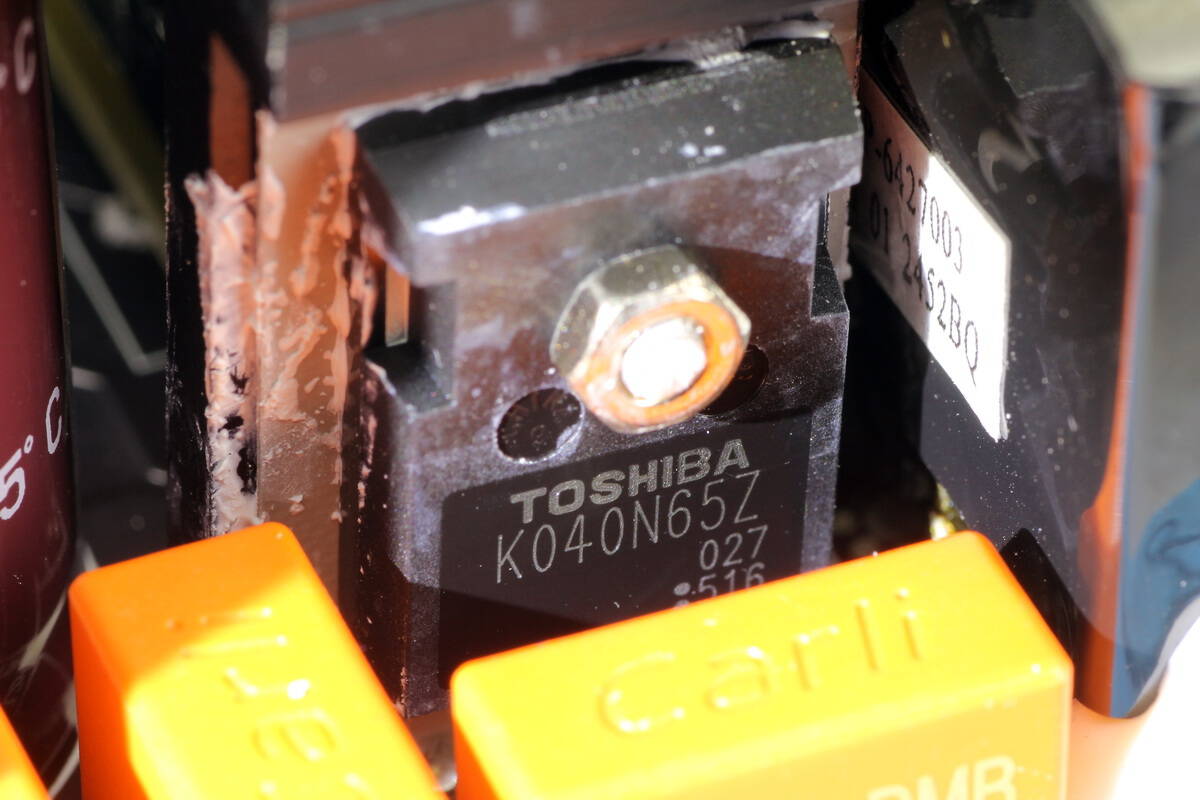
The LLC MOSFET is from Toshiba, model TK040N65Z, and shares the same model as the PFC MOSFETs.

The resonant capacitors are from Carli, rated at 0.1 μF, 630 V.
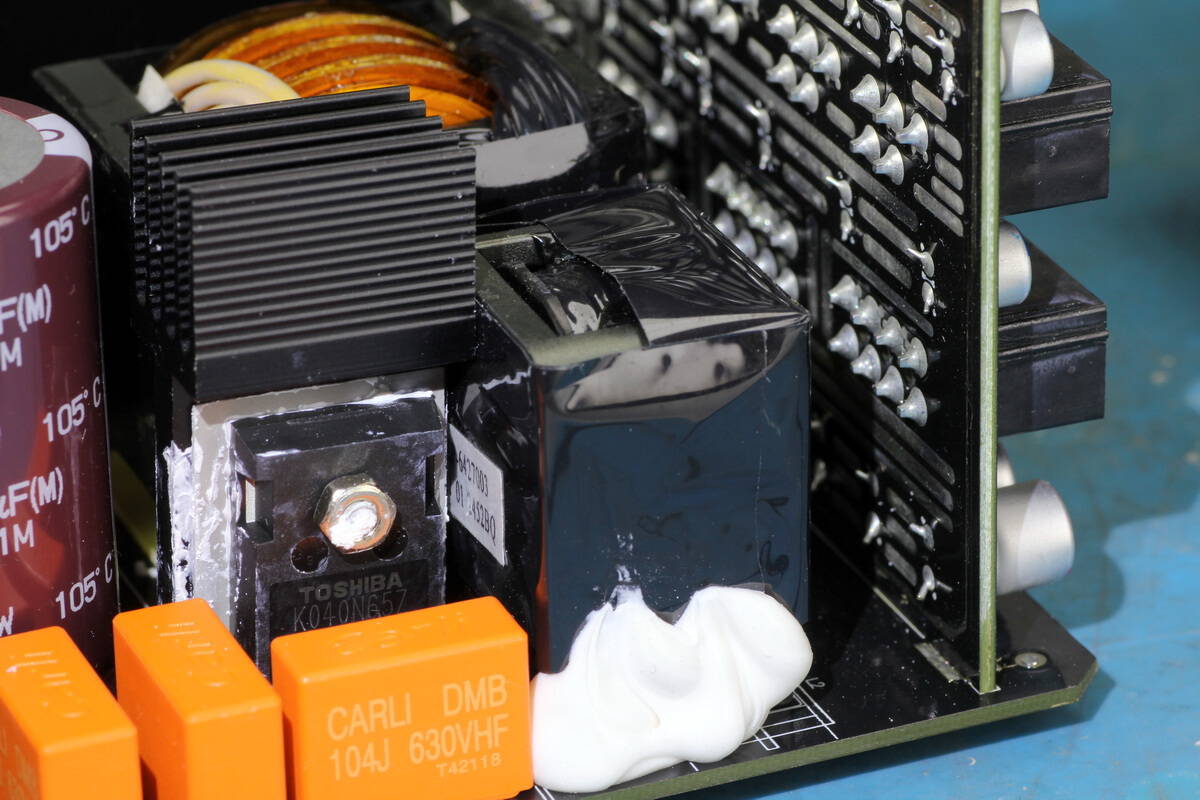
The resonant inductor is insulated with tape and reinforced with adhesive at the base.

The transformer primary is wound with multi-layer insulated wire, the secondary is fabricated with soldered copper foils, and a bakelite board is installed at the base for insulation.

Copper foils are soldered to the base of the transformer to enhance current-carrying capability.
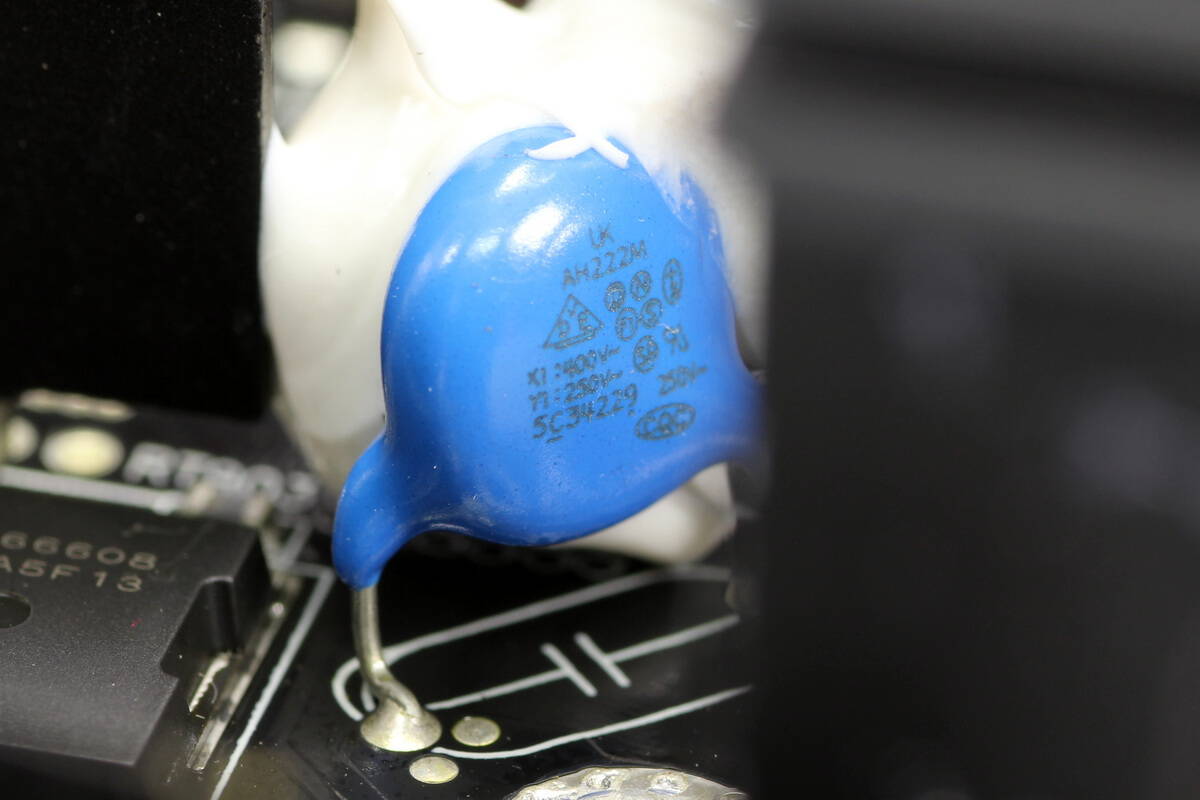
The blue Y-capacitor is from Walsin, part number AH222M.

A heat sink is installed beneath the transformer to dissipate heat from the synchronous rectifiers.

The synchronous rectifier controller is from NXP, model TEA2095. It is a dual-channel synchronous rectifier controller with two built-in drivers, capable of driving two synchronous rectifiers simultaneously and supporting independent operation. It is designed for use in LLC resonant power supplies and comes in an SO8 package.

Six synchronous rectifiers are installed in the middle of the heat sink.

The synchronous rectifiers are from AOS, model AOTL66608. They are NMOS transistors with a voltage rating of 60 V and an on-resistance of 0.7 mΩ, packaged in TOLLA.

Here is the information about AOS AOTL66608.
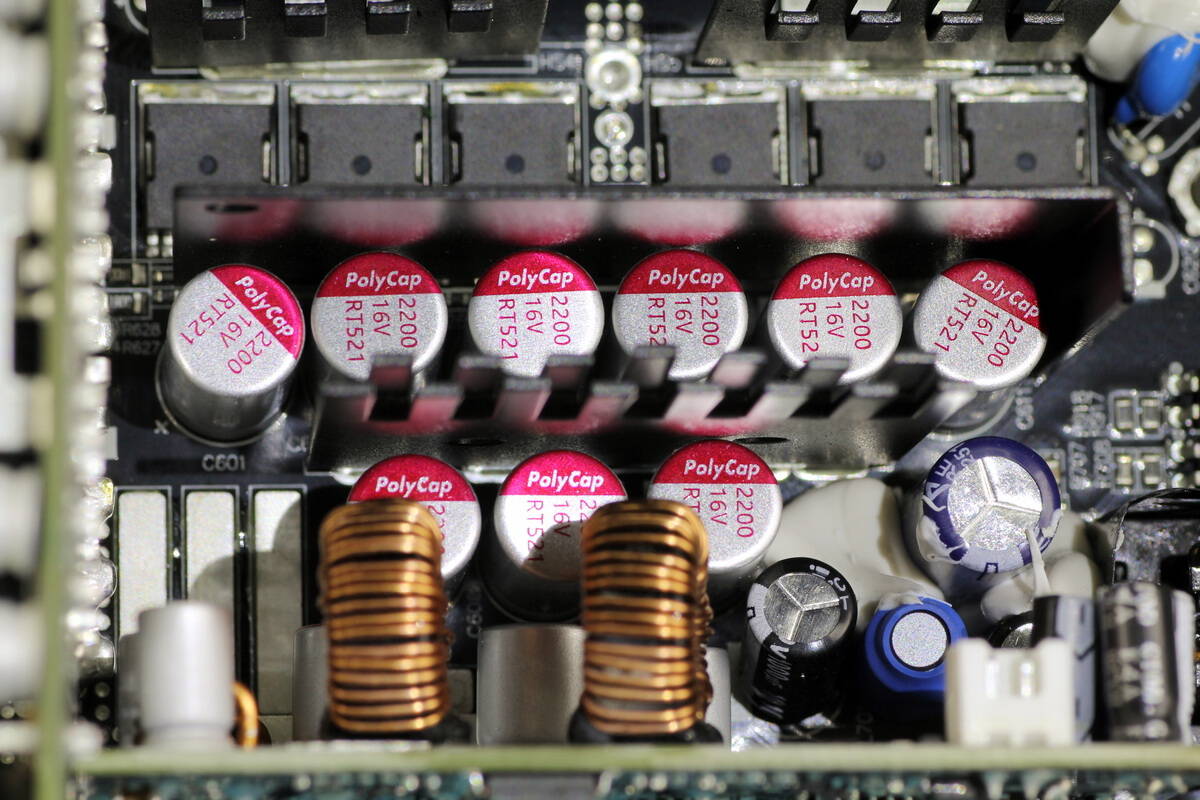
The output filter capacitors are from PolyCap, part of the RT series of solid-state capacitors, rated at 2200 μF, 16 V, with a total of nine units installed.

Copper foils are also soldered to the bases of the corresponding filter capacitors to enhance current-carrying capability.
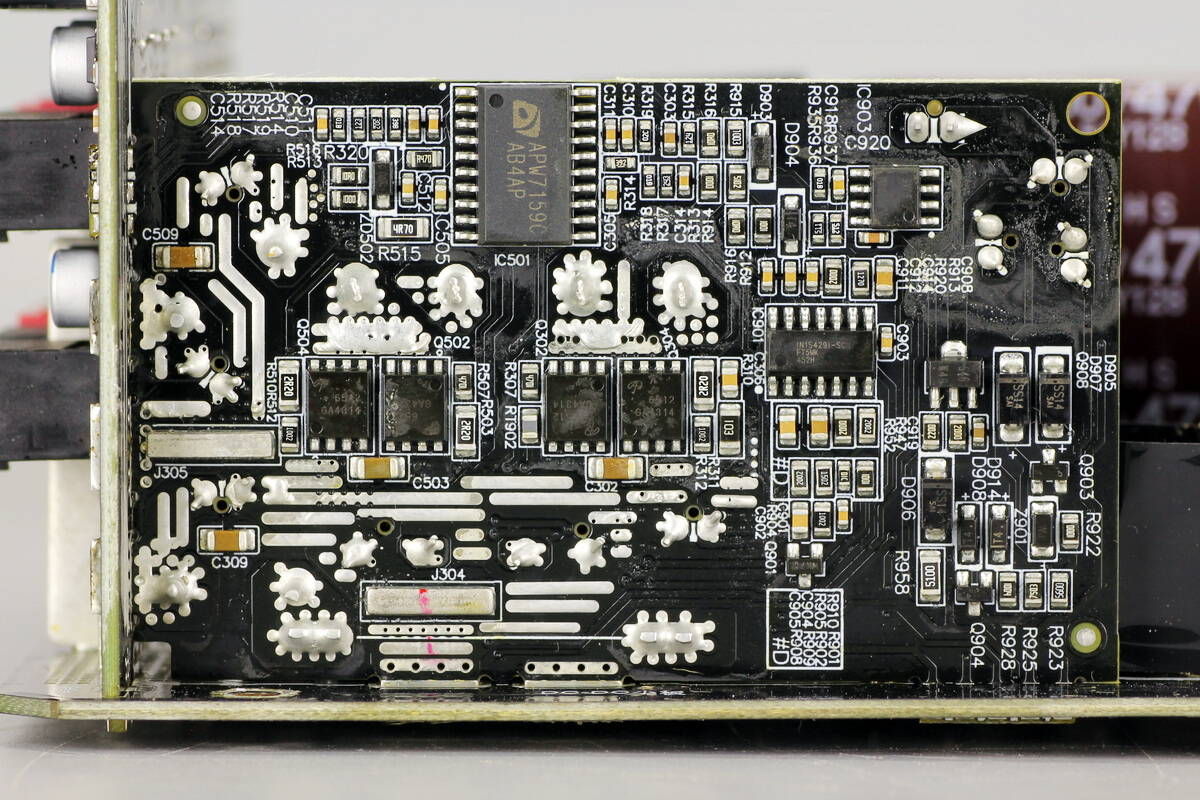
On the outer side of the buck PCB, there is a synchronous buck controller, synchronous buck MOSFETs, a control IC, and a voltage comparator.

Inside, it contains filter capacitors, buck inductors, synchronous buck MOSFETs, and voltage comparators, among other components.

The synchronous buck controller for 3.3 V and 5 V is from ANPEC, model APW7159C. It is a dual-channel synchronous buck controller with excellent output voltage regulation, integrated soft-start and patented soft-stop features, a built-in bootstrap diode, and support for output overvoltage, undervoltage, and overtemperature protection. It comes in an SOP-20 package.
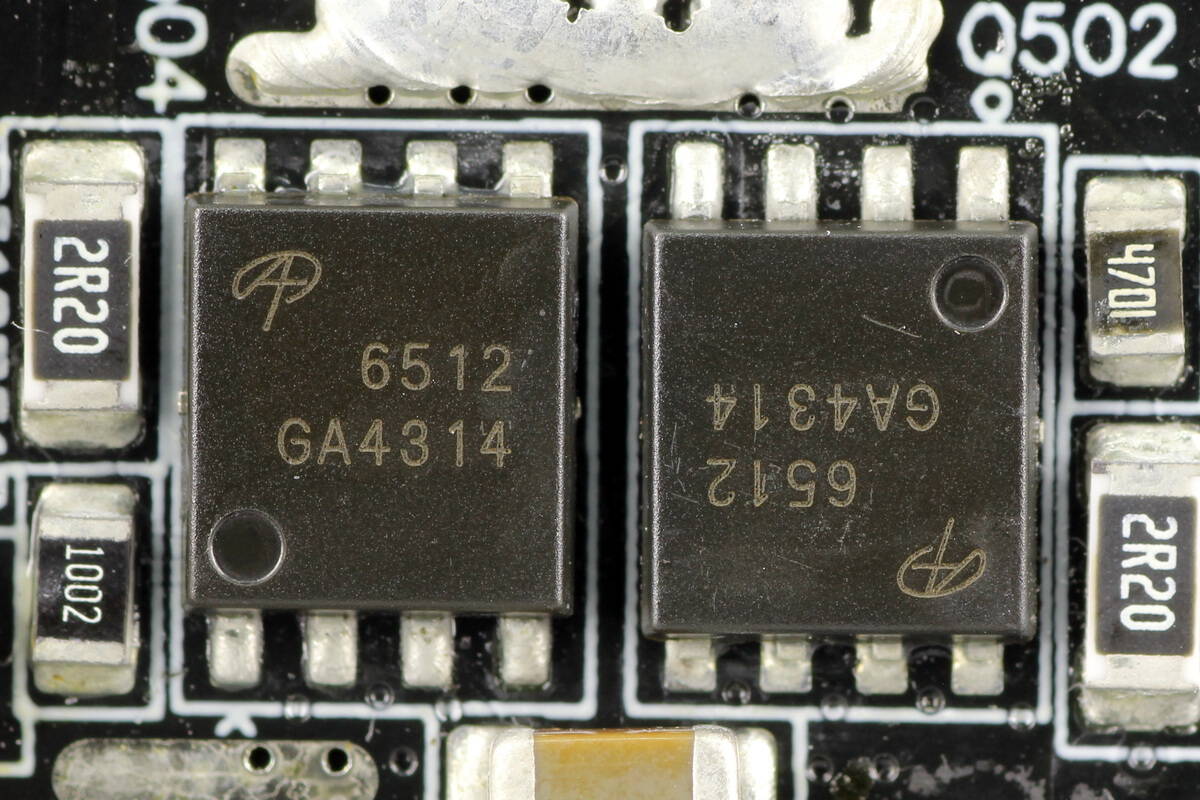
The synchronous buck MOSFETs are from AOS, model AON6512. They are NMOS transistors with a voltage rating of 30 V and an on-resistance of 1.7 mΩ, featuring low gate charge and high current capability, suitable for DC/DC converter applications, and come in a DFN 5×6 package.

Another set of synchronous buck MOSFETs has the same model, and a thermistor is installed between the two sets of switches for temperature monitoring.

The buck inductors are wound with enameled wire, with a bakelite board installed at the base for insulation.

A synchronous buck MOSFET is also installed on the inductor side.
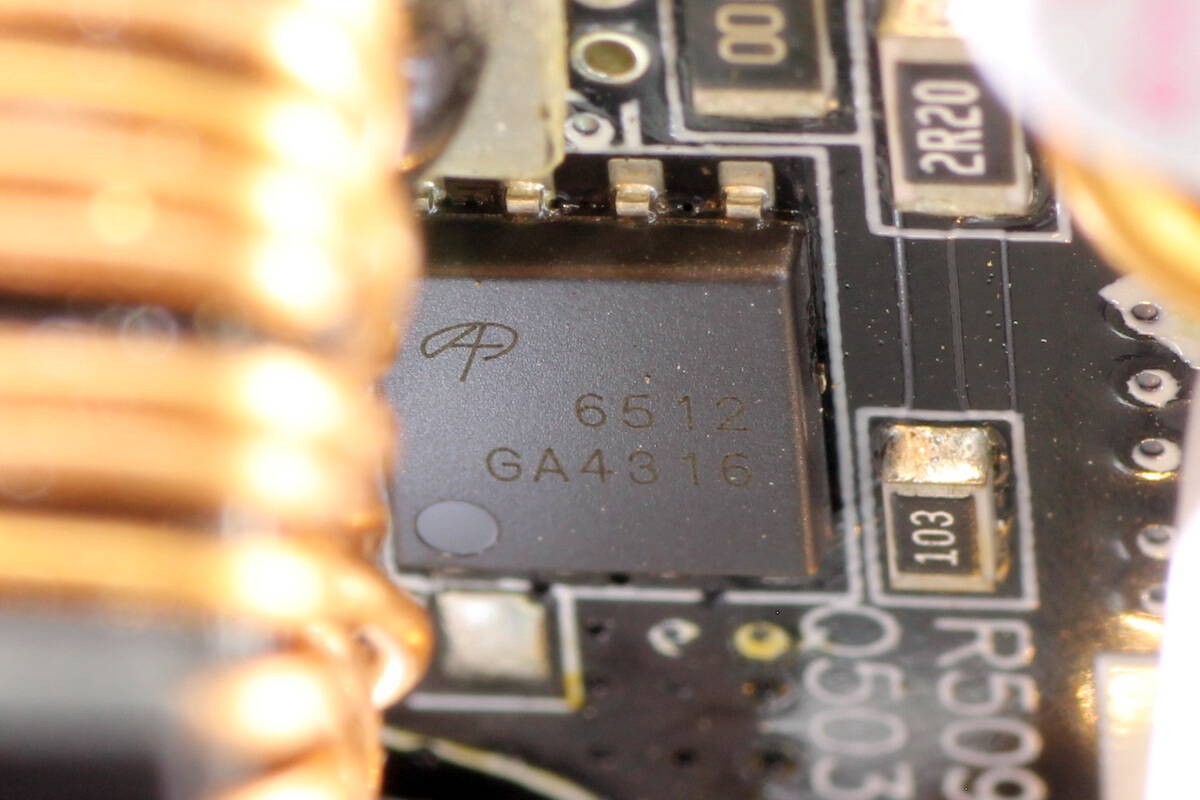
The other set of synchronous buck MOSFETs has the same model.

The input filter capacitors are from PolyCap, rated at 470 μF, 16 V, with a total of two units.

The output filter capacitors are rated at 1000 μF, 6.3 V.

The filter inductor is wound with enameled wire.
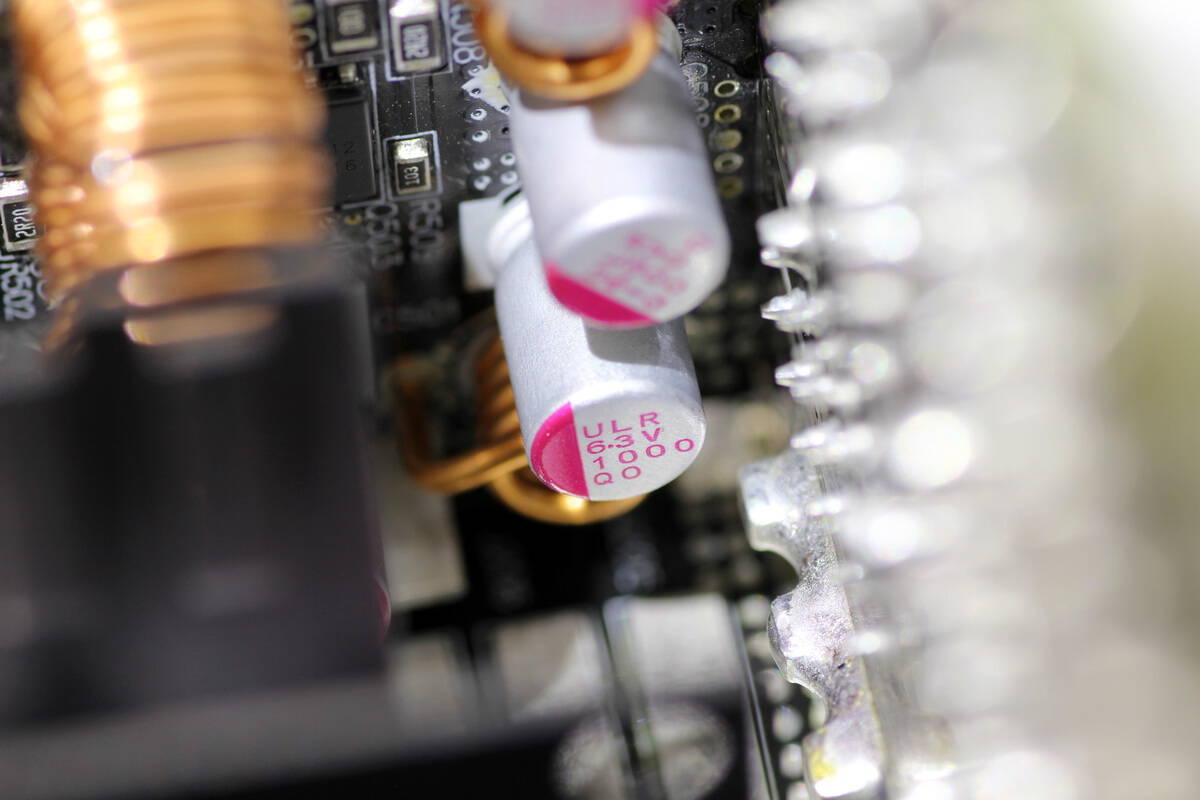
A close-up view shows the other set of filter capacitors and filter inductors.
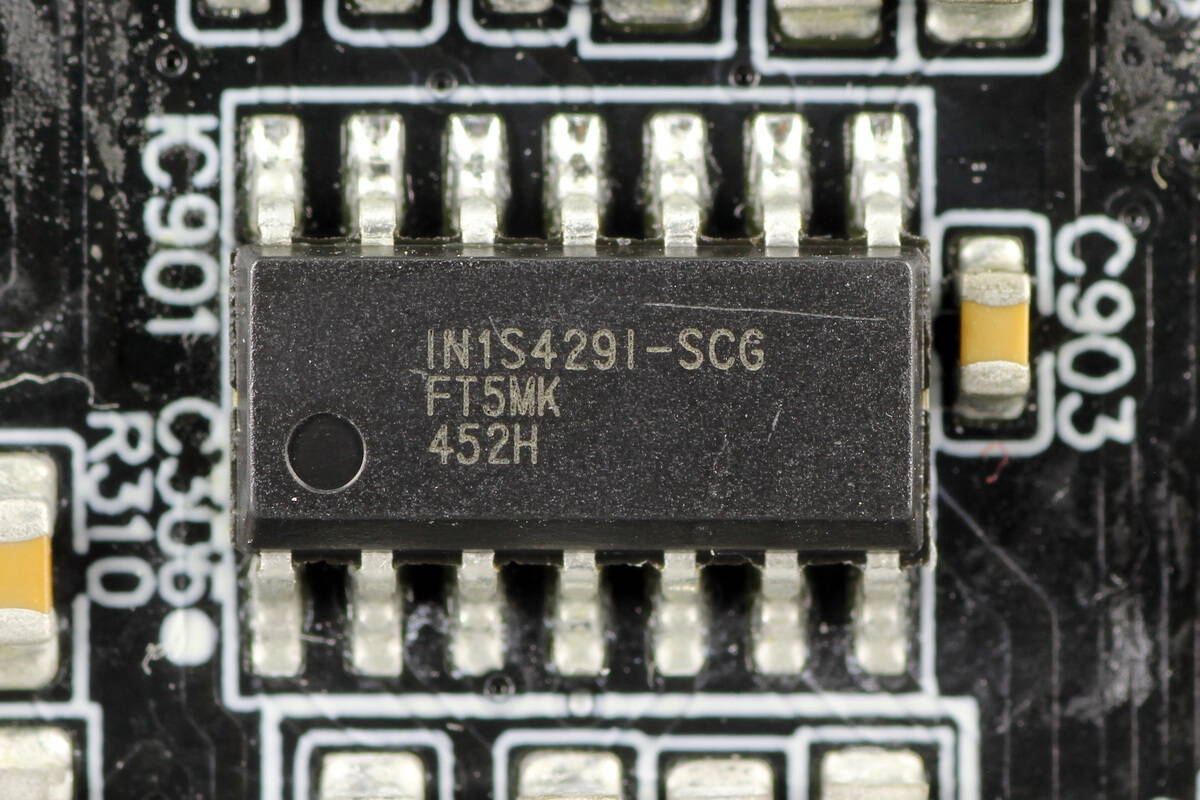
The power management IC is from Infineontrix, model IN1S429I-SCG. It provides overvoltage, undervoltage, overcurrent, short-circuit, and overtemperature protection for 3.3 V, 5 V, and 12 V outputs, and comes in an SOP-14 package.

The voltage comparator is from DIODES, model AS393MTR-G1. It is a dual-channel, low-power, low-offset voltage comparator and comes in an SO-8 package.
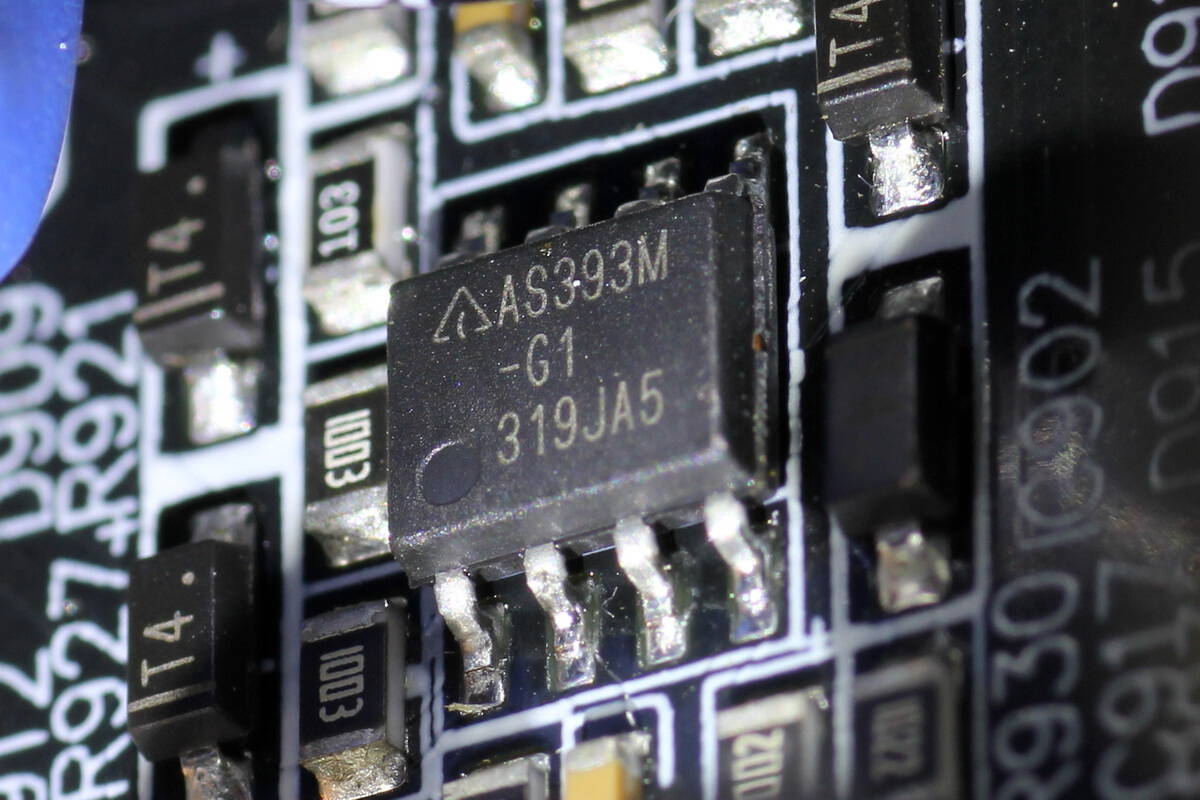
On the back side, there is another voltage comparator of the same model.
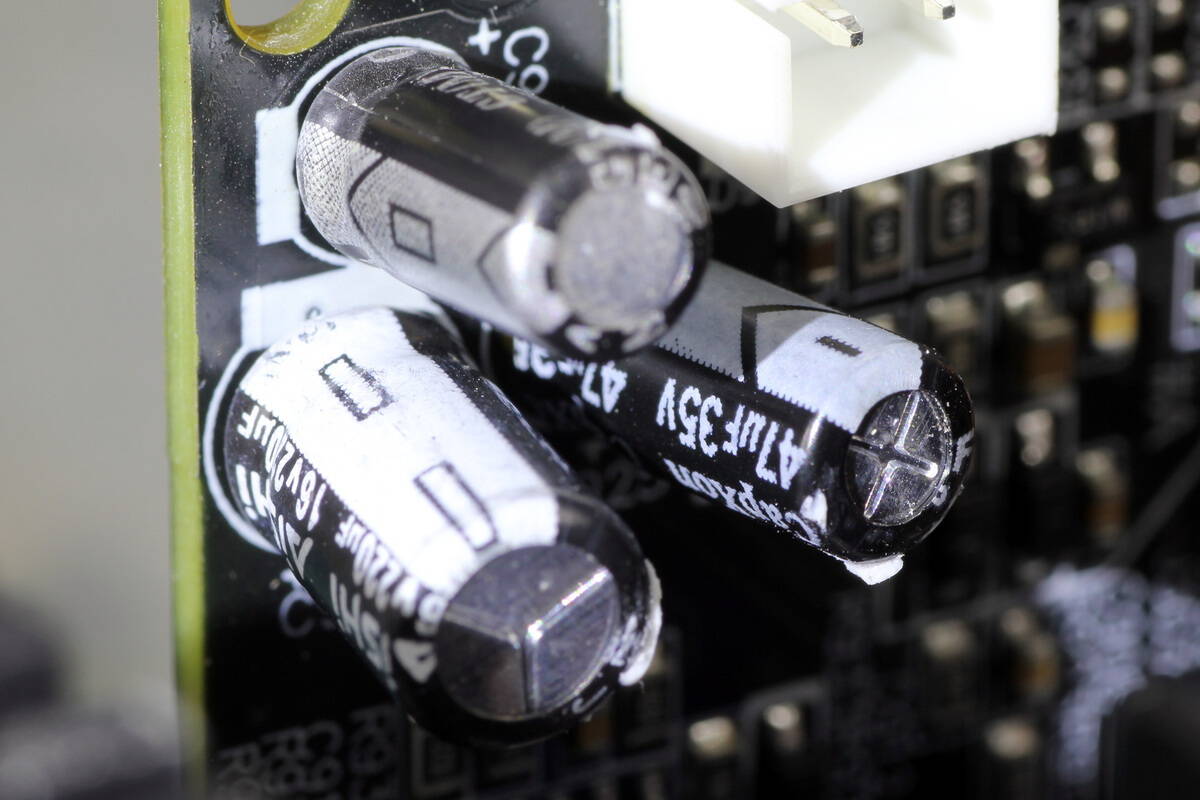
There are three filter capacitors, one of which is from CapXon, rated at 47 μF, 35 V.
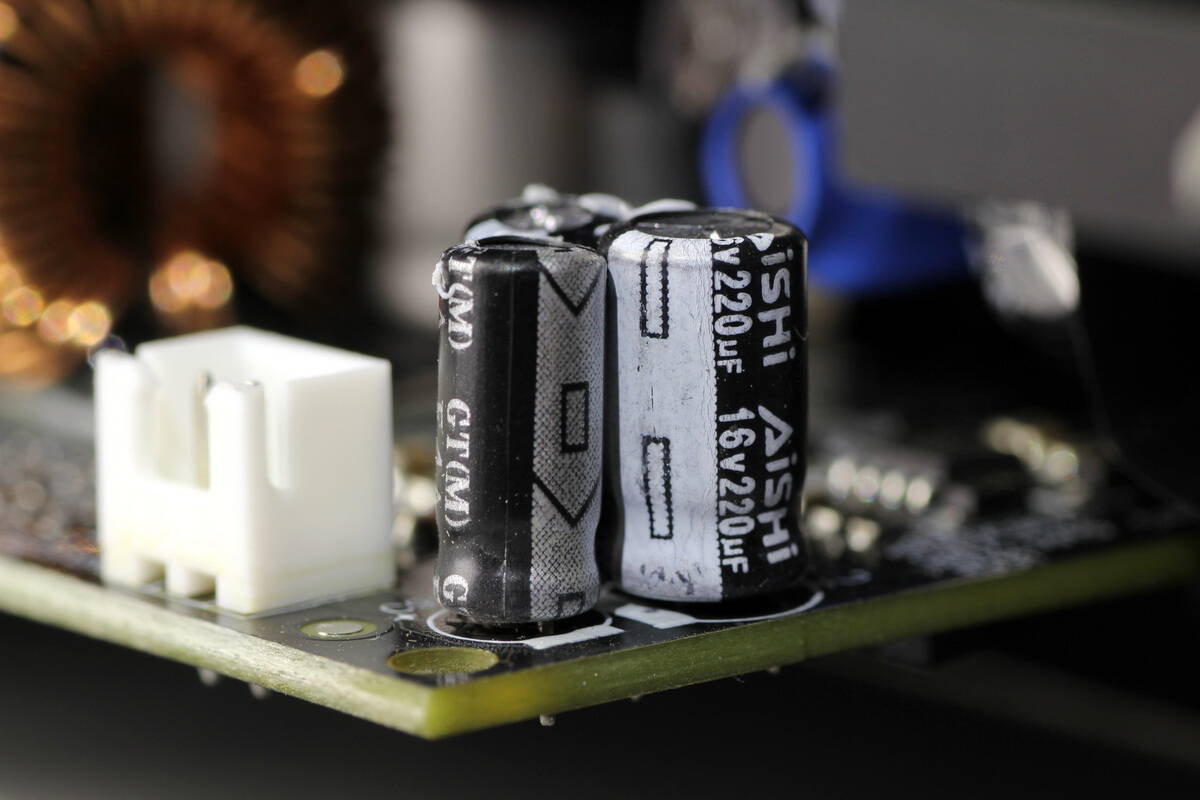
Another capacitor is from AiSHi, rated at 220 μF, 16 V.

The remaining capacitor is from SAMXON, rated at 4.7 μF, 50 V.

The standby power IC is from Infineontrix, model IN2P380C. It integrates a 650 V-rated MOSFET and comes in an SOP-8 package.

The power supply filter capacitor is from CapXon, rated at 47 μF, 35 V.
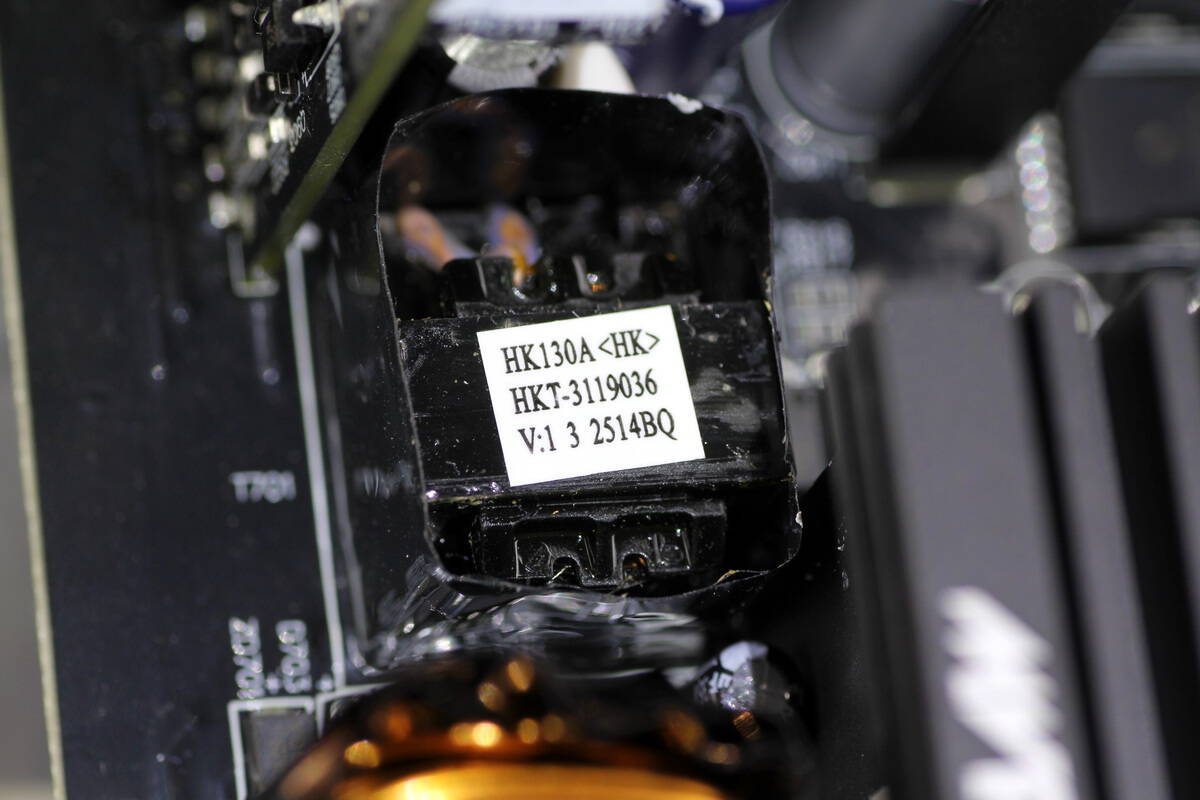
The standby power transformer is insulated with tape winding.

An Everlight EL817 optocoupler is used for output voltage feedback.
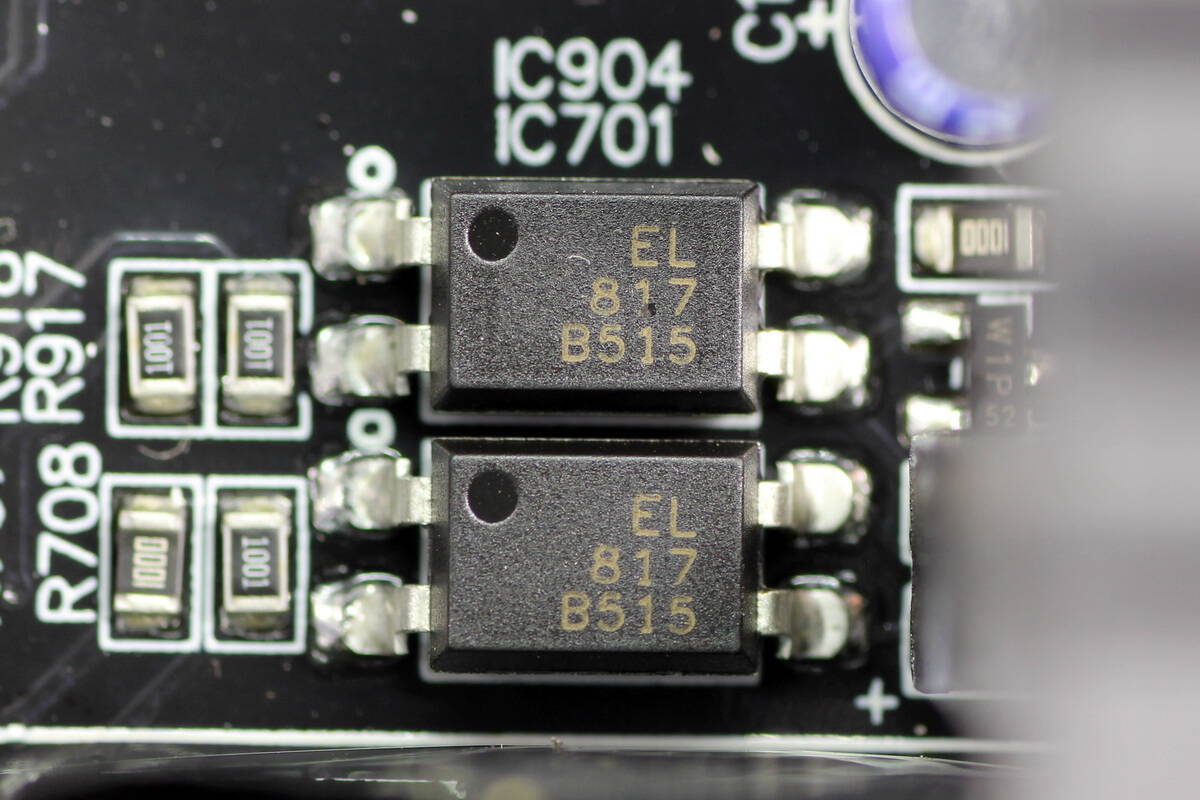
A close-up of the other two EL817 optocouplers.

A close-up view of the EL817 optocoupler.

The output filter capacitor is from AiSHi, rated at 1000 μF, 10 V.

The filter inductor is insulated with a heat-shrink sleeve.

The other filter capacitor has the same specifications.

The filter capacitor is rated at 2200 μF, 10 V.

At the output, a module PCB is installed with soldered copper foils to enhance current-carrying capability and equipped with solid capacitors for filtering.
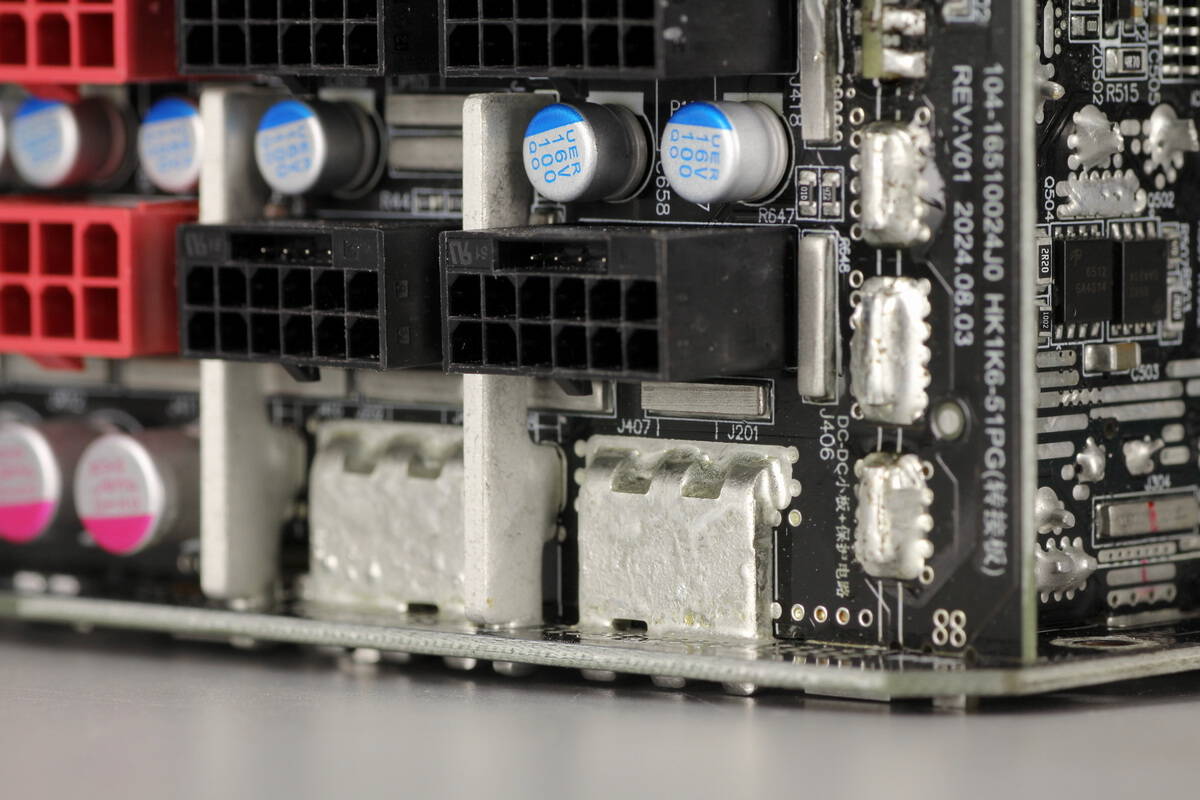
The positive and negative terminals of the power supply are connected via soldered copper foils.
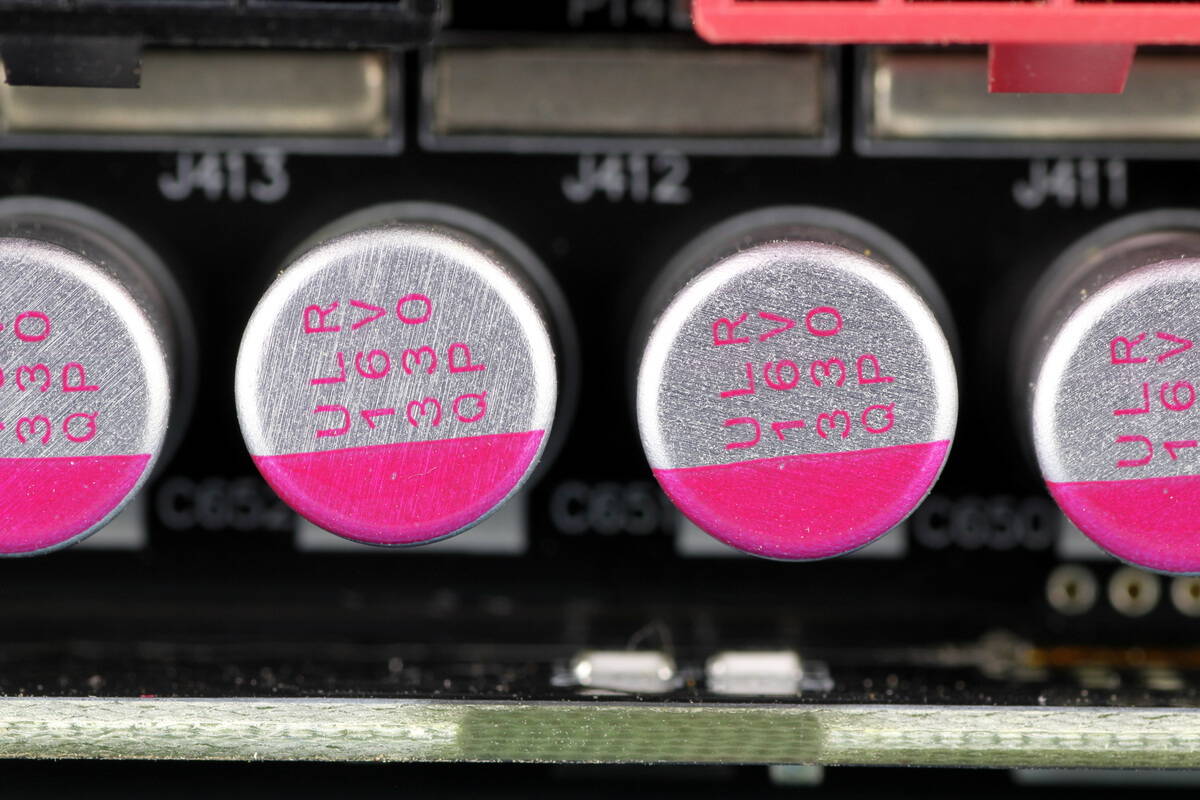
There are three types of filter capacitors on the PCB. The 12 V filter capacitors are from SAMXON, part of the ULR series of solid capacitors, rated at 330 μF, 16 V, with a total of seven units.
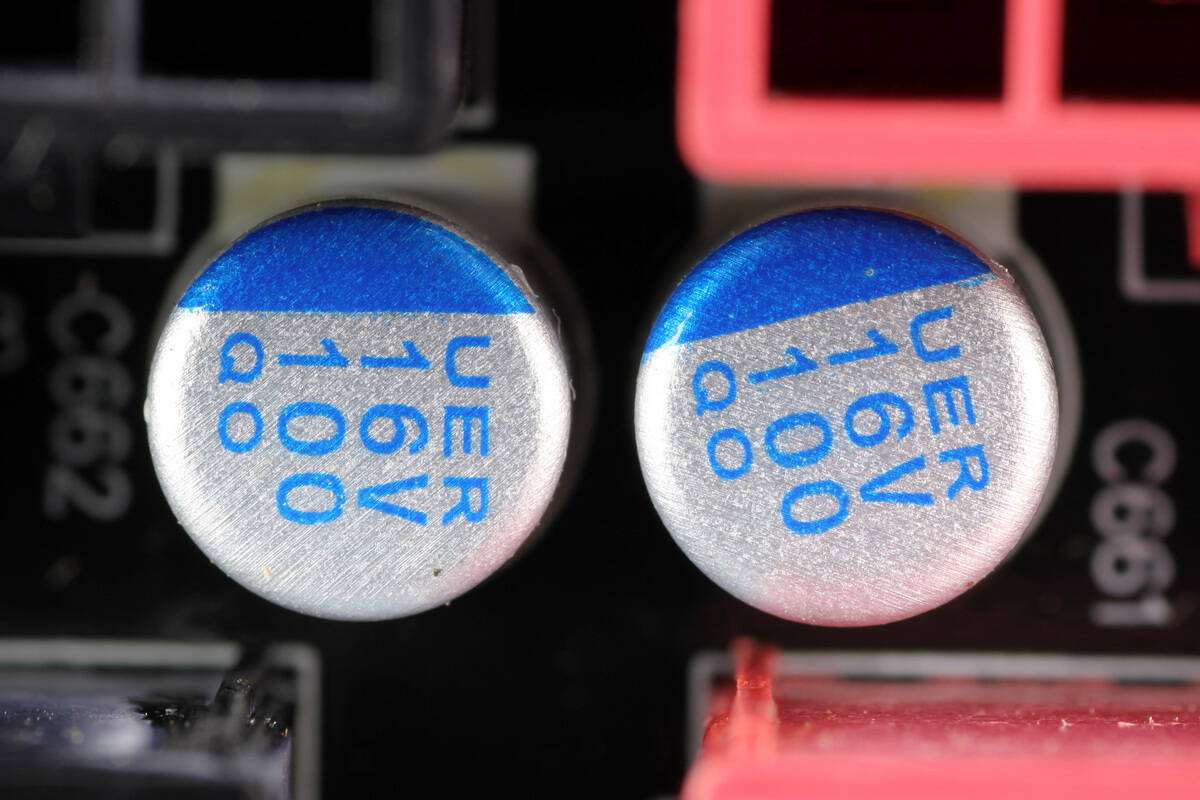
The UER solid capacitors are rated at 100 μF, 16 V, with a total of 14 units.
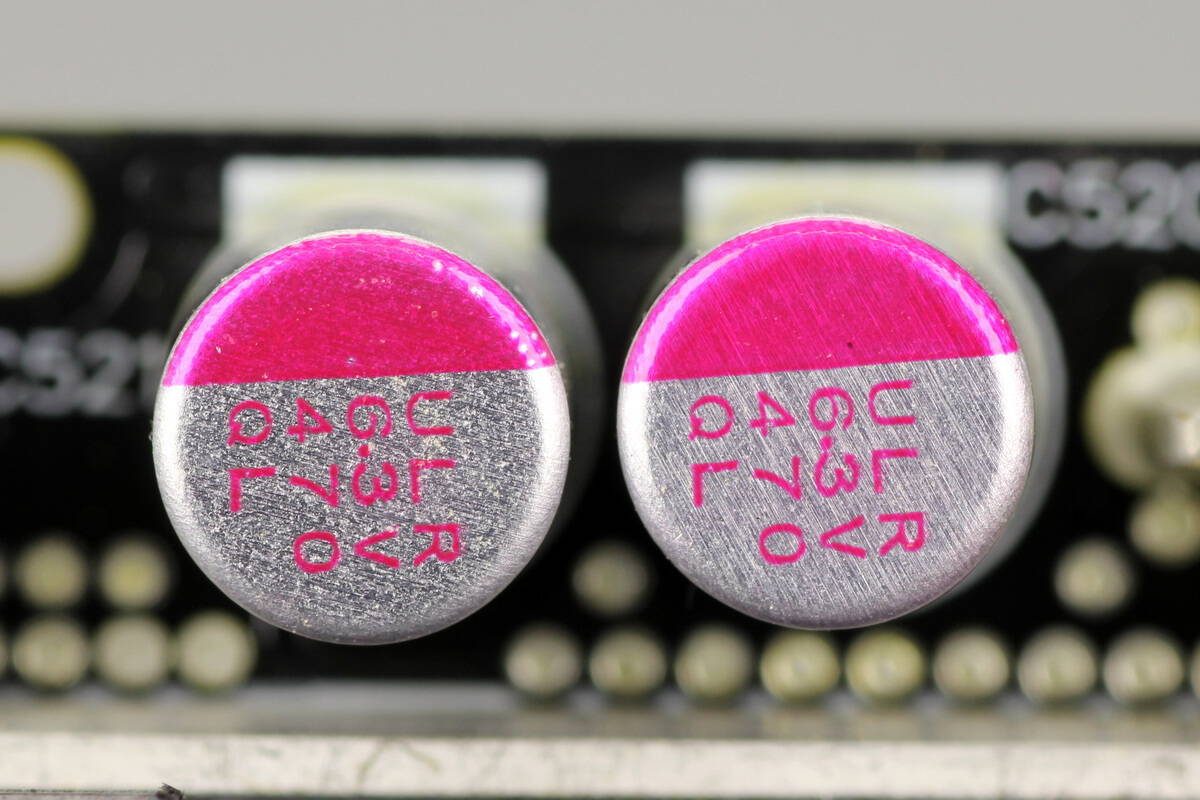
The ULR solid capacitors are rated at 470 μF, 6.3 V, with a total of eight units.

The synchronous buck converter is from DIODES, model LSP5523. It integrates MOSFETs, supports a 27 V input voltage and 3 A output current, features programmable soft-start, cycle-by-cycle overcurrent and short-circuit protection, and input undervoltage lockout. It comes in an ESOP-8L package.

A close-up of the 10 μH inductor.
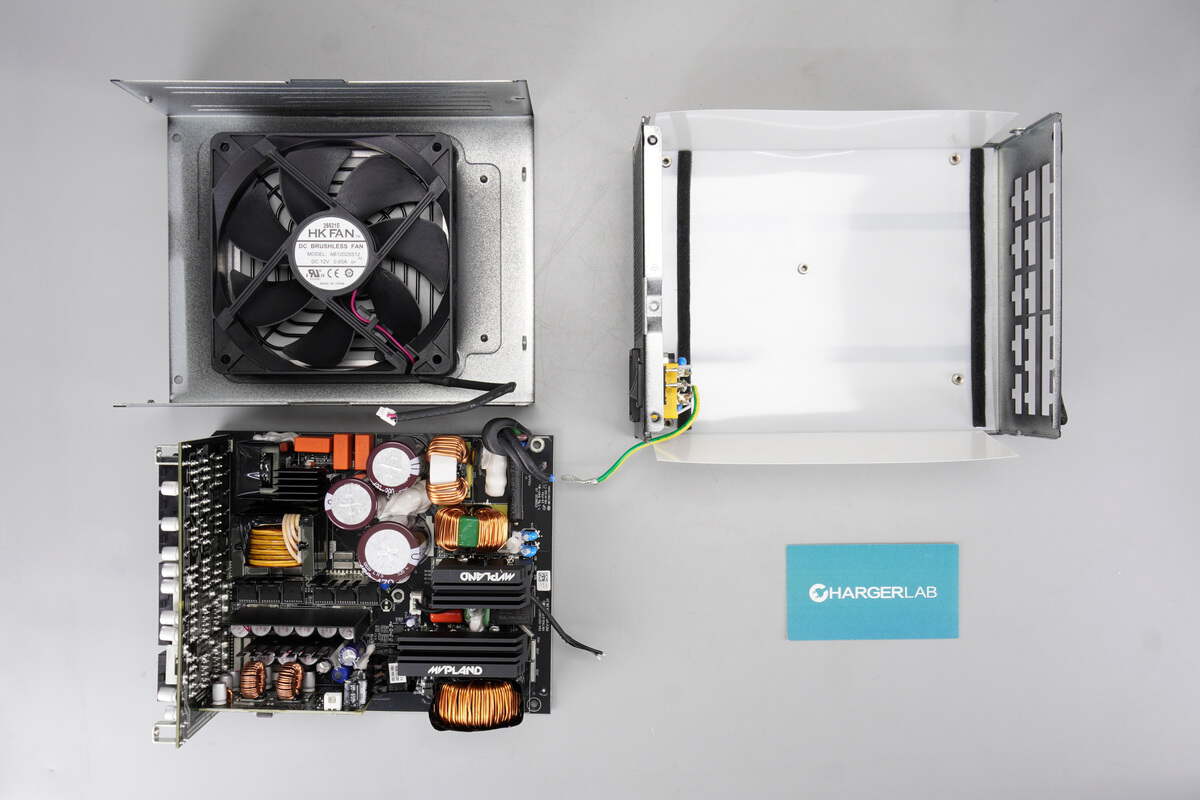
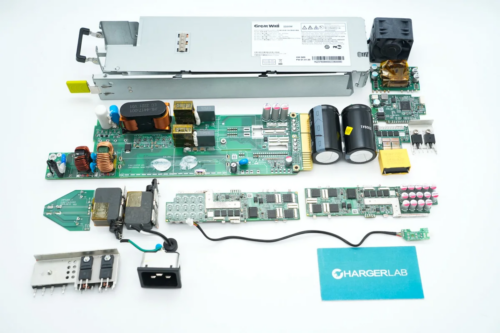
Well, those are all components of the HuntKey MVP P1600X Platinum SiC Fully Modular PSU.
Summary of ChargerLAB

Here is the component list of the HuntKey MVP P1600X Platinum SiC Fully Modular PSU for your convenience.
This model, HK1K6-51PG, supports an input voltage of 115–240 V. Its main output is 12 V with a current of 133 A, while the 5 V and 3.3 V outputs each provide 30 A. The power supply features a fully modular design, offers four PCIe 5.1 interfaces, and supports dual-CPU and multi-GPU interconnection applications.
After taking it apart, we found that it uses an active PFC + half-bridge LLC + synchronous rectification + DC-DC architecture. It is controlled by an NXP HKP6288AT main controller, which is a digital power IC for PFC and LLC control. The PFC and LLC MOSFETs are Toshiba TK040N65Z, and the PFC rectifiers use STMicro STPSC8H065D silicon carbide diodes.
The synchronous rectifier controller is an NXP TEA2095 paired with AOS AOTL66608 synchronous rectifiers. The synchronous buck controller is an ANPEC APW7159C, paired with AON6512 MOSFETs for 3.3 V and 5 V step-down outputs. High-voltage filter capacitors are from NCC, and solid capacitors are from PolyCap and SAMXON. The construction is robust, and the components are reliable.
Related Articles:
1. Teardown of Baseus 145W 25000mAh Power Bank (E0028H)
2. Teardown of 3Y POWER 1600W SiC Server Power Supply (YSEF1600EM)
3. Teardown of BULL 67W GaN Digital Display Power Strip (GNV-ML1676)